.webp)
 20 Apr 2026
Microsoft Dynamics 365 has become a continuously evolving enterprise platform shaped by frequent updates, integrations, and changing business processes. As implementations scale, maintaining stability across interconnected modules makes Dynamics 365 automated testing significantly more complex.
Traditional script-based approaches often struggle to keep pace. Even minor interface or workflow changes can disrupt validation cycles, increasing maintenance effort and elevating risks during regression testing in Dynamics 365. This reactive model can slow releases and reduce confidence in system updates.
To address this, organizations are increasingly adopting AI in software testing. Modern AI Automation Tool capabilities such as AI-driven test case generation, adaptive self-healing test automation, and more efficient AI-powered regression testing are helping teams implement scalable AI regression test automation strategies suited to continuously evolving Dynamics environments.
Why Traditional Script-Based Testing No Longer Fits Dynamics 365?
Legacy test automation frameworks were designed for stable applications with predictable UI and limited integration dependencies. Dynamics 365 environments, however, operate with:
-
Continuous Microsoft updates and feature releases
-
Multi-module interconnected workflows
-
Custom extensions and integrations
-
Cloud-native architecture with variable runtime conditions
These complex environments make Dynamics 365 API automation testing essential for validating integrations, ensuring reliable API responses, and maintaining end-to-end workflow accuracy.
Script-based approaches struggle because they rely on deterministic test paths. Even minor UI changes can break entire test suites. Maintenance overhead increases exponentially, diverting QA resources from strategic quality initiatives.
As organizations scale their ERP and CRM operations, Dynamics 365 automated testing must move beyond static execution models.
Understanding AI-Native Testing Execution
AI-native testing introduces cognitive intelligence into the validation lifecycle. Instead of executing predefined scripts, AI models interpret application behavior, learn patterns, and adapt test execution dynamically.
This transformation impacts several core testing dimensions:
1. Intelligent Test Design
Traditional frameworks require manual scripting for every functional scenario. AI enables AI-driven test case generation, where test scenarios are automatically created based on system workflows, user interactions, and historical defect patterns.
This reduces dependency on manual documentation and ensures broader coverage across business processes.
2. Autonomous Test Maintenance
One of the biggest limitations of legacy automation is brittle test scripts. AI introduces self-healing test automation, allowing systems to detect UI changes, adjust locators, and maintain execution continuity without human intervention.
This significantly lowers maintenance cost and improves test reliability.
3. Predictive Quality Assurance
AI models analyze execution logs, defect trends, and performance metrics to predict high-risk modules. This shifts testing from reactive validation to proactive risk mitigation.
The Role of AI in Dynamics 365 Regression Testing
Regression testing in enterprise ERP systems is particularly complex. Dynamics 365 implementations often involve:
-
Financial transaction workflows
-
Supply chain dependencies
-
Customer interaction pipelines
-
Third-party integrations
Manual regression cycles become time-intensive and error-prone.
With AI-powered regression testing, execution becomes adaptive. AI prioritizes test cases based on impact analysis, ensuring critical business functions are validated first.
This is especially valuable in Regression testing in Dynamics 365, where updates can affect multiple modules simultaneously.
AI regression frameworks introduce:
-
Smart test prioritization
-
Automated anomaly detection
-
Real-time execution optimization
-
Continuous regression validation
These capabilities ensure that system upgrades do not compromise operational continuity.
The Evolution of Testing Tools: Moving Beyond Automation
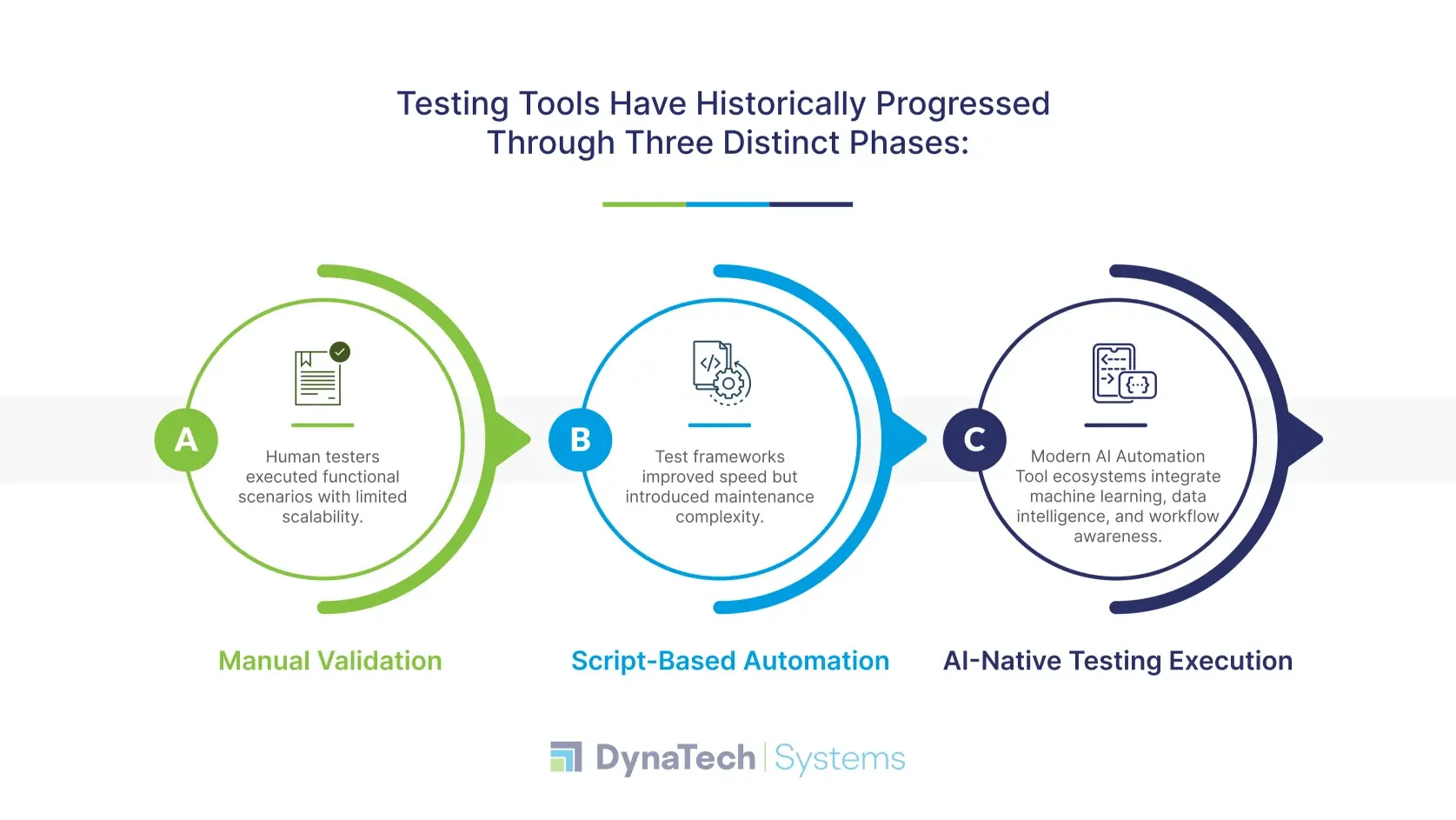
This evolution represents a paradigm shift where testing tools are no longer passive executors but active decision-making systems.
AI-Led Test Case Generation in Dynamics Environments
Generating test cases for Dynamics 365 requires deep understanding of business logic. AI models trained on transactional workflows can automatically identify:
-
Critical financial processes
-
Supply chain exception scenarios
-
Customer lifecycle interactions
-
Integration touchpoints
AI-driven test case generation ensures that testing aligns with real operational usage rather than theoretical coverage.
This improves both functional accuracy and business relevance of test suites.
Self-Healing Automation: Eliminating Test Fragility
One of the defining features of AI-native testing is resilience.
Self-healing test automation enables frameworks to adapt to UI and workflow changes without manual script updates. This is achieved through:
-
Computer vision-based UI recognition
-
Semantic element identification
-
Behavioral pattern analysis
For Dynamics 365 implementations undergoing frequent updates, this capability ensures uninterrupted testing continuity.
AI Regression Test Automation for Continuous Delivery
Modern enterprises operate on continuous integration and deployment pipelines. Testing must align with this velocity.
AI regression test automation supports DevOps strategies by enabling:
-
Parallel execution across modules
-
Dynamic test scheduling
-
Real-time failure diagnostics
-
Automated root cause analysis
This allows organizations to maintain release agility without compromising system stability.
Strategic Benefits of AI in Dynamics Testing
Adopting AI-native testing models delivers measurable enterprise outcomes:
-
Operational Efficiency
Automation intelligence reduces manual intervention and accelerates validation cycles.
-
Cost Optimization
Lower maintenance overhead and reduced defect leakage translate into long-term savings.
-
Business Continuity
Predictive testing ensures critical processes remain stable during updates.
-
Improved User Experience
Higher software reliability leads to better adoption across business teams.
Aligning Testing Strategy with Digital Transformation
Dynamics 365 is often central to enterprise digital transformation initiatives. Testing must evolve in parallel with modernization efforts.
Organizations implementing advanced analytics, AI agents, and integrated workflows require testing strategies that can interpret system complexity.
AI-native frameworks bridge this gap by combining automation with contextual intelligence.
The Emergence of Intelligent Testing Platforms
Modern AI Automation Tool platforms are designed as enterprise accelerators rather than isolated QA utilities.
They integrate with:
-
DevOps pipelines
-
Cloud infrastructure
-
Data analytics systems
-
Business process frameworks
This integration transforms testing from a technical function into a strategic enabler of innovation.
Future Outlook: Cognitive Quality Engineering
Enterprise testing is steadily progressing toward cognitive quality engineering, where validation systems operate with contextual intelligence rather than static execution logic. In Dynamics 365 environments, this shift enables testing frameworks to continuously learn from production signals, adapt validation strategies, and maintain quality assurance as an ongoing operational capability rather than a periodic activity.
-
Autonomous Test Environment Provisioning
AI-driven platforms will automatically provision and optimize test environments based on release complexity, infrastructure dependencies, and data requirements. This ensures realistic validation conditions while reducing manual configuration overhead.
-
AI-Driven Performance Benchmarking
Cognitive testing introduces continuous performance intelligence by monitoring system behavior against predictive benchmarks. This allows early detection of performance degradation and supports proactive scalability management.
-
Real-Time User Behavior Validation
By analyzing live interaction patterns, AI systems can identify workflow deviations and generate relevant test scenarios. This ensures validation remains aligned with actual business usage rather than predefined assumptions.
-
Continuous Compliance Monitoring
AI-enabled frameworks will embed compliance checks into testing cycles, automatically validating system changes against governance policies, regulatory standards, and security requirements.
-
Quality as an Intelligent Governance Layer
As these capabilities mature, quality assurance will evolve into a strategic governance function that safeguards system resilience, accelerates innovation, and supports sustainable enterprise transformation.
Conclusion: Transitioning to AI-Native Testing Execution
Testing strategies around Dynamics 365 are reaching a turning point. As releases become more frequent and system landscapes grow more interconnected, relying only on scripted validation is proving difficult to sustain. Quality teams are expected to validate faster, cover more scenarios, and still maintain confidence in business-critical workflows.
This is where the growing role of AI in software testing is becoming practical rather than experimental. Approaches such as AI-driven test case generation, adaptive self-healing test automation, and more focused AI-powered regression testing are helping organizations rethink how they manage regression testing in Dynamics 365 environments without adding operational overhead.
With its newly introduced AI Automation Tool, DynaTech, as a Microsoft solutions partner, is working toward making Dynamics 365 automated testing more resilient and scalable for real enterprise release cycles. The objective is not simply to automate tests, but to enable sustainable AI regression test automation that keeps pace with continuous platform evolution while supporting long-term system stability.