 29 Apr 2026
Enterprise Dynamics 365 environments evolve continuously. Monthly Microsoft updates, configuration changes, integrations, and custom extensions introduce a constant risk of regression. As a result, Dynamics 365 test automation is no longer a tactical decision. It is a foundational requirement for operational continuity, release confidence, and business resilience.
Organizations running Dynamics 365 Finance and Operations traditionally rely on Microsoft’s Regression Suite Automation Tool (RSAT) to automate business process validation. However, the emergence of AI testing for Dynamics 365 introduces a different paradigm. This shift has also introduced purpose-built platforms designed specifically for enterprise Dynamics environments. Modern teams are increasingly evaluating AI automation testing tools that allow functional users to create automation using plain English while reducing long-term script maintenance.
Understanding how RSAT compares with AI-powered regression testing is essential for organizations planning long-term Dynamics 365 quality assurance strategies.
The gap becomes more visible in environments where Dynamics 365 Finance and Operations and Customer Engagement operate together but cannot be tested within a single framework.
Understanding RSAT in Dynamics 365 Testing
RSAT is designed to enable functional users to convert recorded business processes into automated test cases. By leveraging Task Recorder, organizations can capture transactional workflows and replay them across environments without writing code. This aligns with Microsoft’s intent to democratize Dynamics 365 automated testing tools, making automation accessible beyond engineering teams.
Key functional characteristics of RSAT include:
- Recording business processes in Finance and Operations applications
- Executing automated regression tests across sandbox environments
- Parameterizing test steps using Excel-based data sets
- Integration with Azure DevOps for test execution and reporting
- Validation of expected values, messages, and UI control states
- Chaining test cases for end-to-end scenario validation
- Execution within role-based security contexts
RSAT version 2.0 introduced usability improvements such as simplified Excel parameter management and enhanced validation capabilities aligned with Task Recorder updates. These enhancements reduce the effort required for user acceptance testing during Microsoft updates or configuration deployments.
From a technical standpoint, RSAT is particularly effective for:
- Stable transactional workflows
- Standard business process regression validation
- Functional user-driven automation initiatives
- Environments with minimal UI variability
However, RSAT’s architecture remains fundamentally deterministic. It relies on predefined steps and static validations, which limits adaptability in dynamic enterprise landscapes.
Limitations of Traditional RSAT-Driven Automation
While RSAT remains a critical component of Microsoft’s Dynamics 365 automated testing tools ecosystem, organizations encounter scalability and maintenance challenges as environments mature.
Some technical limitations include:
1. Static Test Logic
RSAT executes recorded steps sequentially. Any UI changes, field relocations, or process variations can break test scripts, requiring manual updates. This increases maintenance overhead in highly customized implementations.
2. Limited Intelligence in Defect Detection
RSAT validates predefined conditions. It cannot autonomously identify anomalies outside scripted expectations, which restricts coverage in complex regression scenarios.
3. Dependency on Manual Test Authoring
Functional users must record and maintain test cases continuously. In large enterprise deployments, this introduces operational bottlenecks.
4. Performance Testing Constraints
RSAT is primarily designed for functional regression validation rather than performance, load, or predictive quality analytics.
5. Platform Scope Limitation
RSAT is designed specifically for Dynamics 365 Finance and Operations applications and does not support Dynamics 365 Customer Engagement. This means core business functions such as sales, customer service, and field operations running on CE cannot be included in automated regression using RSAT.
It also does not extend to external web applications, third-party portals, or integration touchpoints outside the F&O interface.
In enterprise environments where both F&O and CE operate together, this creates a fragmented testing approach. Teams often rely on multiple tools or manual validation for CE workflows, which increases effort and limits true end-to-end test coverage.
These constraints create the need for a more adaptive testing approach, particularly as organizations adopt cloud-native architectures and continuous delivery models.
The Emergence of AI-Powered Testing in Dynamics 365
AI-driven frameworks represent a shift from script-based validation to intelligent test orchestration. In the context of AI vs RSAT testing, artificial intelligence enhances the depth, scalability, and resilience of regression validation processes.
Modern AI-powered regression testing solutions incorporate capabilities such as:
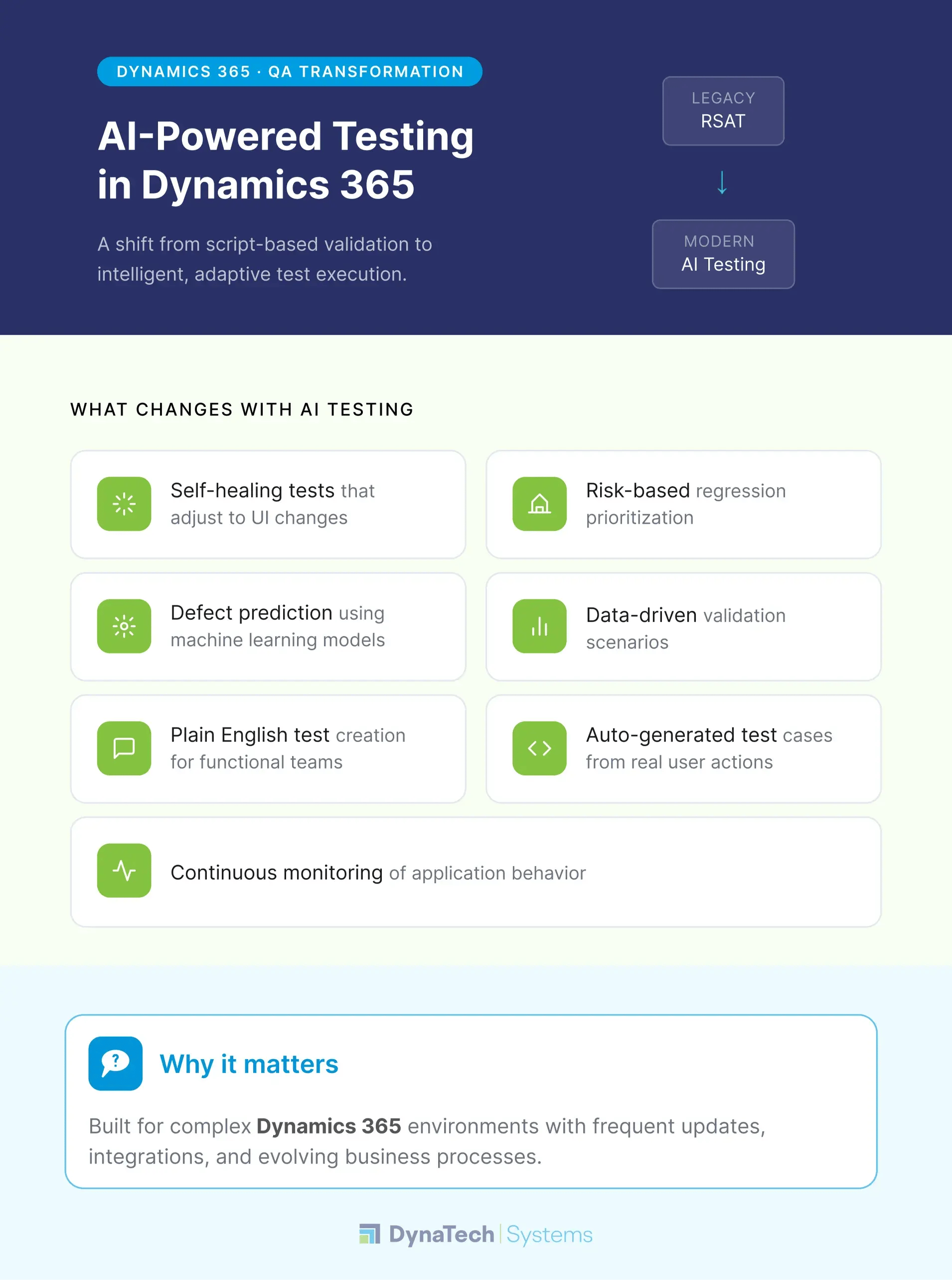
- Self-healing test scripts that adapt to UI changes
- Automated test case generation based on user actions, enabling plain English test automation for functional and QA teams.
- Risk-based regression prioritization
- Intelligent data-driven validation scenarios
- Continuous monitoring of application behavior
These capabilities directly address the operational complexity of large Dynamics 365 ecosystems where frequent updates and integrations are common.
AI-enabled Dynamics 365 quality assurance frameworks also extend beyond functional validation to include:
- Integration validation across microservices
- API testing automation
- Predictive release risk scoring
This represents a broader transformation from automation as execution to automation as intelligence.
DynaTech AI Testing: Engineering Adaptive Quality Assurance
DynaTech’s approach to Dynamics 365 test automation integrates artificial intelligence with enterprise-grade testing frameworks. Instead of replacing RSAT entirely, DynaTech positions AI testing as an augmentation layer that enhances automation maturity.
The architecture of DynaTech’s AI testing for Dynamics 365 focuses on:
Intelligent Regression Optimization
AI algorithms analyze historical defect data, usage patterns, and system dependencies to prioritize regression coverage. This reduces execution cycles while maintaining risk visibility.
Purpose-Built Automation for Dynamics 365
DynaTech has also developed an AI-powered Dynamics 365 automation testing tool designed to simplify automation ownership for functional consultants and QA teams. The platform enables business workflows to be authored in natural language and executed through AI-driven virtual user automation, reducing reliance on scripting-heavy frameworks.
Self-Adaptive Test Execution
Unlike static playback models, DynaTech’s automation frameworks adjust to UI and workflow variations automatically, significantly reducing the effort required to maintain regression libraries alongside RSAT-driven testing.
End-to-End Testing Intelligence
Testing extends beyond Finance and Operations to include Dynamics 365 Customer Engagement, integrations, APIs, analytics layers, and external systems, enabling true end-to-end validation across the business ecosystem.
DevOps Integration
AI-driven testing pipelines align with Azure DevOps and cloud deployment strategies, enabling continuous validation throughout the release lifecycle.
Advanced Reporting and Predictive Insights
Real-time dashboards and predictive analytics provide stakeholders with actionable insights into release readiness and quality trends.
Plain English Automation and Execution Evidence
Modern testing initiatives also require transparency and traceability. AI-driven execution provides video recordings, execution logs, and step-by-step reasoning behind automated actions. This helps stakeholders understand how tests were executed and increases confidence in automated regression outcomes.

Transform Your Software Testing Strategy
Leverage expert-led test automation to improve quality, speed, and reliability.
RSAT vs AI Testing: A Technical Comparison
|
Dimension |
RSAT |
DynaTech AI Testing |
|
Test Creation |
Task Recorder-based |
Custom Extension-based recording |
|
Script Maintenance |
Manual updates |
Self-healing mechanisms |
|
Regression Coverage |
Process-specific |
Risk-based dynamic coverage |
|
Integration Testing |
Limited |
End-to-end ecosystem validation |
|
Predictive Analytics |
Not available |
Built-in AI insights |
|
DevOps Alignment |
Azure DevOps integration |
Continuous intelligent pipelines |
|
Platform Coverage |
Limited to Dynamics 365 Finance & Operations only, no support for Customer Engagement workflows
|
Supports Dynamics 365 F&O, Customer Engagement, portals, and web applications |
|
Scalability |
Moderate |
Enterprise-scale automation |
|
Quality Intelligence |
Static validation |
Predictive defect detection |
When evaluating AI vs RSAT testing, organizations must consider architectural objectives rather than viewing the tools as direct substitutes.
From a technical governance perspective, RSAT remains relevant for baseline regression validation. AI-enabled automation, however, supports strategic transformation toward intelligent testing ecosystems.
Choosing the Right Automation Strategy
The decision between RSAT and AI-driven automation should align with organizational maturity, customization complexity, and release velocity.
RSAT is suitable when:
- Business processes are stable and standardized
- Automation initiatives are functionally driven
- Testing scope is limited to transactional workflows
Why Choose DynaTech AI-Powered Test Automation
The platform provides complete execution transparency through video evidence, step-level logs, and AI reasoning insights. Teams can review exactly how automated scenarios were executed and why specific actions were performed, improving trust in automated regression outcomes.
AI-driven Dynamics 365 automated testing tools become essential when:
- Environments involve heavy customization and integrations
- Release cycles are continuous
- Predictive quality assurance is required
- Enterprise-scale regression coverage is necessary
- Testing must extend beyond D365 F&O to portals, integrations, and web applications
- Testing must span both Dynamics 365 Finance and Operations and Customer Engagement environments
In practice, leading organizations adopt a hybrid approach where RSAT supports baseline validation while AI frameworks provide adaptive regression intelligence. AI-driven Dynamics 365 regression automation strengthens RSAT by reducing maintenance effort and expanding coverage.
Strategic Impact of AI-Driven Quality Engineering in Dynamics 365
As Dynamics 365 environments expand across modules, integrations, and updates, testing moves beyond basic validation toward continuous assurance. This makes Dynamics 365 quality assurance a core engineering function rather than a post-deployment activity.
DynaTech, as a Microsoft Solutions Partner, AI-powered regression testing approach reduces script maintenance and improves execution reliability by combining adaptive test logic with DevOps-aligned automation pipelines. This enables testing cycles to remain synchronized with configuration changes, extensions, and release updates without repeated manual rework.
By introducing intelligent prioritization and system-impact visibility, AI-enabled automation helps engineering teams execute more targeted regression validation while maintaining release stability in complex Dynamics 365 ecosystems.
Conclusion: Modernizing Dynamics 365 Quality Assurance Approaches
RSAT remains useful for teams that need repeatable Dynamics 365 test automation for standard business processes. It works well when transaction flows are stable and test cycles are predictable. The challenge begins when environments grow through integrations, extensions, and frequent release updates. In such cases, maintaining recorded regression libraries can demand continuous manual effort.
AI-supported automation helps teams manage this complexity by reducing dependency on static scripts and enabling more focused regression execution across impacted areas. This strengthens Dynamics 365 quality assurance without requiring a complete shift away from existing testing investments.
DynaTech implements adaptive testing frameworks that align automation runs with deployment pipelines and real operational change patterns. For organizations reviewing their Dynamics 365 automated testing tools, the objective should be to extend RSAT-driven validation with approaches that improve maintainability and execution efficiency over time.
Ready to Get Started?
To evaluate practical next steps in modernizing your testing approach, connect with DynaTech’s automation specialists and explore how AI-driven Dynamics 365 test automation can complement your existing RSAT strategy.