 14 May 2026
Security within Microsoft Dynamics 365 has evolved from a configuration task to a board-level governance priority. As enterprises scale global ERP deployments, expand user bases, and integrate third-party systems, the complexity of access control increases exponentially. The result is a heightened need for structured D365 security governance, real-time monitoring, and defensible compliance controls.
While Microsoft provides a robust foundational security model, organizations increasingly require advanced Dynamics 365 security tools to address segregation-of-duties conflicts, privilege creep, audit readiness, and license governance.
Two prominent solutions in this landscape are DynaTech’s Secure D365 security solution and Fastpath security for Dynamics 365. Both enhance Dynamics 365 audit and compliance, yet they differ significantly in architecture, philosophy, and operational impact.
To better understand the foundation behind these security layers, it’s helpful to explore how theDynamics 365 data security framework ensures data protectionand compliance across environments in this detailed guide:
This article provides a technical, business-focused comparison to determine which solution delivers superior strategic value.
The Enterprise Security Governance Gap in Dynamics 365
Dynamics 365 uses a role-based access control (RBAC) framework built on roles, duties, and privileges. Integration with Azure Active Directory strengthens identity controls, and native audit logs track configuration changes.
However, enterprises operating at scale encounter recurring governance challenges:
- Complex role inheritance structures creating hidden access exposure
- Segregation-of-duties (SoD) conflicts across finance and supply chain processes
- Excessive privilege assignments due to role duplication
- Lack of real-time license utilization visibility
- Audit preparation dependent on manual reporting
Without automation, governance becomes reactive rather than continuous. This is where Dynamics 365 security compliance tools like Secure D365 and Fastpath extend the platform’s capabilities.
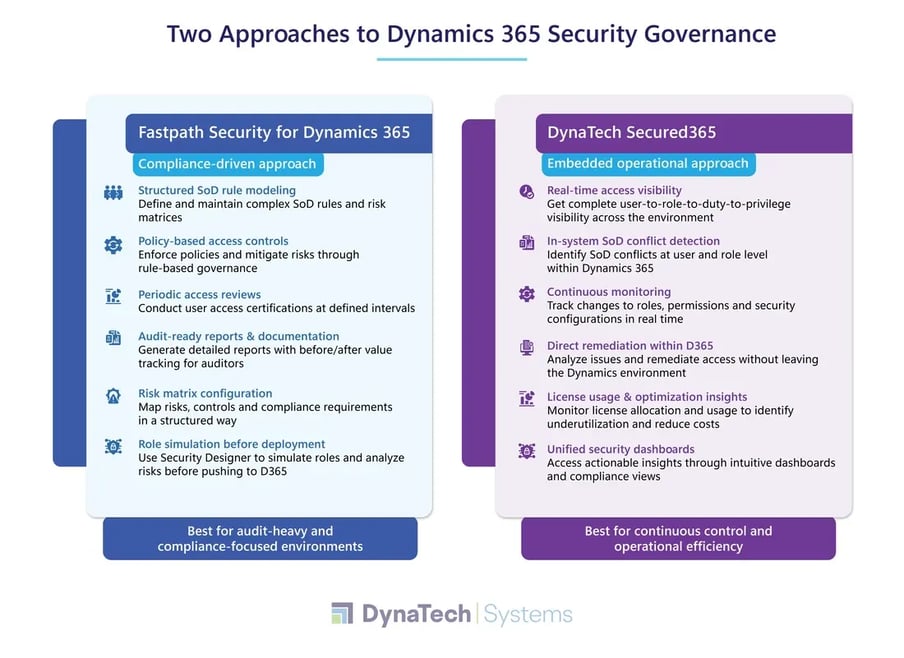
To address these governance challenges, organizations typically adopt one of two distinct approaches to Dynamics 365 security.
Fastpath Security for Dynamics 365: Compliance-Driven Governance
Fastpath Assure is positioned as a Governance, Risk, and Compliance (GRC) solution designed to formalize access controls and automate SoD monitoring across ERP systems.
Core Capabilities
Fastpath typically provides:
- Advanced segregation-of-duties rule modeling
- Risk matrix configuration and policy enforcement
- Access certification workflows
- Audit trail reporting with before/after value tracking
- Structured compliance exports for regulatory documentation
- Security Designer tools for role simulation
Its strength lies in analytical rigor. Enterprises subject to SOX, SOC, or industry-specific regulatory frameworks benefit from its structured SoD analysis and exportable compliance documentation.
Operational Considerations
However, Fastpath is commonly implemented within structured GRC environments where compliance and risk teams manage policy configuration and review cycles. Rule matrices must be defined, maintained, and periodically recalibrated. For organizations without mature GRC teams, this can introduce operational overhead.
Fastpath excels in audit-heavy environments where documentation precision is paramount.
DynaTech’s Secure D365 Security Solution: Embedded Operational Governance
DynaTech’s Secure D365 security solution is purpose-built for Microsoft Dynamics 365 Finance & Supply Chain Management. Instead of operating purely as an external compliance engine, Secure D365 embeds governance directly within the ERP environment.
The approach shifts security from periodic audit preparation to continuous operational control.
Unified Role Intelligence
Secure D365 delivers deep visibility into:
- User-to-role-to-duty-to-privilege mappings
- Menu item–level access exposure
- Cross-company security configurations
- Environment-wide access summaries
Through consolidated dashboards, administrators gain immediate insight into entitlement structures without exporting data externally. This strengthens D365 security governance by making risk transparent and actionable.
Integrated Segregation of Duties
When evaluating Secure D365 vs Fastpath, SoD management is central.
Fastpath provides sophisticated rule-based SoD modeling.
Secure D365 embeds SoD conflict detection directly within Dynamics workflows. Administrators can identify conflicts, analyze impact, and remediate access within the same system. This reduces friction and accelerates corrective action.
Effective SoD management also depends on a clear understanding of Dynamics 365 security roles, duties, and privilege structures, which is explained in detail.
License Optimization as a Governance Multiplier
A defining differentiator is license governance.
Secure D365 provides:
- License allocation visibility
- Usage-based entitlement analysis
- Identification of underutilized licenses
- Optimization recommendations aligned with actual access patterns
This transforms security governance into a cost optimization lever. Most traditional Dynamics 365 security tools focus exclusively on risk detection. Secure D365 uniquely connects compliance with financial efficiency.
Continuous Audit Monitoring
Secure D365 enhances native auditing with:
- Role change tracking
- Permission modification analysis
- Security configuration comparison reports
- Real-time compliance dashboards
Instead of preparing audits reactively, organizations maintain a defensible, continuous compliance posture.
Side-by-Side Comparison: Secured365 vs Fastpath
| Evaluation Criteria | DynaTech Secure D365 Security Solution | Fastpath Security for Dynamics 365 |
| Primary Focus | Combines license governance, segregation of duties (SoD), access conflict detection, audit logging, automation, AD integration, and delegation support within Dynamics 365 | Positioned as an audit and risk management solution with a strong focus on SoD analysis, access reviews, and compliance documentation |
| Segregation of Duties (SoD) | Identifies SoD conflicts at both role and user levels within the Dynamics 365 environment | Analyzes security conflicts within and across roles; supports mitigation tracking and audit documentation |
| Audit & Activity Tracking | Tracks user activities with detailed logs, role assignment approval records, and access monitoring dashboards | Provides audit-focused reporting, structured documentation outputs, and scheduled report delivery for compliance needs |
| License Management | Includes license allocation tracking, inactive user detection, usage visibility, and optimization insights to reduce underutilized licenses | Not positioned primarily as a license optimization tool in its Dynamics 365 offering |
| Security Design / Simulation | Focuses on visibility, conflict identification, and configuration reporting within the live environment | Includes Security Designer functionality, enabling model-based simulations and risk analysis before pushing changes to Dynamics 365 |
| Automation & AD Integration | Supports automation features, including Azure Directory-based user monitoring and automatic deactivation scenarios | Provides workflow approval capabilities; Azure AD-based automation is not prominently positioned in the D365 listing |
| Remediation Approach | Enables administrators to analyze and act within the Dynamics 365 ecosystem | Supports structured governance workflows for review and approval processes |
| Ideal Enterprise Fit | Organizations seeking embedded operational governance combined with license optimization and security visibility | Enterprises with structured compliance programs requiring formal audit documentation and advanced SoD modeling |
Strategic Interpretation
The core distinction between Secure D365 vs Fastpath is architectural philosophy.
Fastpath formalizes governance through structured compliance modeling. It is powerful in environments where external regulatory scrutiny dominates security strategy.
Secure D365 operationalizes governance within Dynamics itself. It integrates entitlement transparency, SoD enforcement, audit visibility, and license optimization into a unified framework.
In practice, this difference becomes more visible in large-scale enterprise environments. In a recent engagement with a global manufacturing organization operating Dynamics 365 Finance & Supply Chain Management across multiple regions, access governance challenges had started to impact audit readiness and operational efficiency. The environment had evolved with duplicated roles, inconsistent permission structures, and limited visibility into segregation-of-duties conflicts.
By implementing an embedded governance approach within Dynamics 365, the organization was able to significantly reduce SoD conflicts, improve audit traceability, and gain clearer visibility into license utilization. More importantly, security controls became part of daily operations rather than a periodic audit exercise.
For organizations seeking to elevate Dynamics 365 security compliance tools beyond documentation and toward continuous control, Secure D365 represents a governance approach focused on embedded operational visibility within Dynamics 365.
Beyond Security: Building a Controlled ERP Ecosystem
Security governance is most effective when aligned with process and operational control across the ERP landscape. Organizations implementing Secure D365 often extend their governance maturity beyond access control into broader system-level optimization.
DynaTech supports this by enabling a connected Dynamics 365 ecosystem that brings together security governance, process visibility, and operational efficiency. This includes manufacturing accelerators, compliance frameworks, and governance capabilities tailored for Dynamics 365 Finance & Supply Chain Management environments.
In practice, this means organizations are not only able to detect access risks but also align security controls with business workflows, reduce process-level exposure, and improve transparency across finance, supply chain, and operational functions.
This ecosystem-driven approach differentiates DynaTech from standalone GRC vendors. The focus is not just on identifying risks, but on building a controlled, scalable, and performance-oriented ERP environment.
Final Verdict: What’s the Best Fit for Your Business?
Both platforms strengthen Dynamics 365 audit and compliance.
Fastpath is compliance-centric, structured, and ideal for enterprises with complex regulatory obligations and mature risk management teams.
Secure D365 is operationally integrated, strategically efficient, and uniquely positioned to combine security governance with license cost optimization.
For organizations seeking a scalable, embedded, and business-aligned approach to D365 security governance, DynaTech’s Secure D365 security solution delivers broader enterprise value.
As ERP landscapes become more interconnected and regulatory expectations increase, the future of security lies not in isolated compliance engines, but in continuous, intelligent governance embedded at the core of the system.
The question is no longer whether to enhance Dynamics 365 security – but whether your chosen solution supports compliance alone or drives enterprise-wide governance transformation.