 23 Oct 2026
When evaluating a Dynamics 365 implementation partner, a Microsoft badge can tell you that a partner has met a defined qualification. It does not, by itself, tell you how that qualification was earned, which capabilities were assessed, or whether the partner's experience aligns with the complexity of your own business.
Most buyers already know Dynamics 365 by name. What they can't always tell is whether a partner's work holds up under the real complexity of Finance, Supply Chain, or Sales at scale, or whether it's only been tested against a sales pitch.
That distinction matters.
Microsoft's partner program separates broad solution capability from deeper, workload-specific expertise. A partner can hold a Solutions Partner designation for Business Applications without necessarily holding a specialization in Finance, Sales, or Supply Chain. A specialization goes a step further by applying additional requirements to a particular area of Dynamics 365 expertise.
For organizations considering a major ERP, CRM, or business applications program, understanding that difference makes the credential more useful. It also provides a better framework for evaluating the partner behind the badge.
In 2026, this framework has also evolved. Microsoft has updated its customer-facing Solutions Partner badge names while retaining the six underlying solution paths that determine requirements, scoring, and specializations. Business Applications now maps to the customer-facing Solutions Partner for AI Business Solutions badge, while the Business Applications solution path remains the foundation for Dynamics 365 specializations such as Finance, Sales, and Supply Chain.
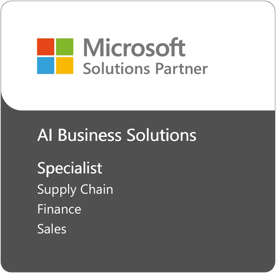
DynaTech Systems currently holds Microsoft's AI Business Applications specialization in Supply Chain, Finance, and Sales. The more useful question, however, is not simply what the badges say. It is what Microsoft requires a partner to demonstrate to earn them, and what that evidence means for a customer evaluating delivery capability.
Designation vs. Specialization: What Is the Difference?
The terms Solutions Partner, designation, specialization, and badge are often used interchangeably. They describe different layers of Microsoft's partner framework.
The Business Applications Designation
A Solutions Partner designation demonstrates broader capability within one of Microsoft's six solution paths. Those paths include Business Applications, Data & AI (Azure), Digital & App Innovation (Azure), Infrastructure (Azure), Modern Work, and Security. Microsoft describes the Business Applications designation as evidence of broad capability in delivering solutions with Dynamics 365 and Power Platform.
For Business Applications, Microsoft uses a Partner Capability Score based on three categories:
- Performance
- Skilling
- Customer success
The designation requires a minimum Partner Capability Score of 70 out of 100, with points distributed across five subcategories: net customer adds, intermediate certifications, advanced certifications, usage growth, and deployments. Microsoft also requires at least one point in each category and subcategory.
This is the broad qualification.
It answers a question such as:
Does this partner demonstrate the organisational capability, skills, customer activity, and delivery experience expected in the Business Applications solution area?
It does not answer a more specific question such as:
How deep is this partner's experience in Dynamics 365 Finance or Supply Chain Management?
That is where specializations become relevant.
The Specialization
Microsoft describes specializations as deeper validation that sits on top of the relevant Solutions Partner designation. A partner must first have the aligned designation and then meet additional requirements specific to the specialization.
The current Business Applications specialization portfolio includes Finance, Sales, Service, Supply Chain, Small and Midsize Business Management, and Agentic Business Solutions.
So the distinction is straightforward:
Designation = broad solution-area capability.
Specialization = deeper capability in a defined workload or practice area.
For a customer, that difference is useful because a general Business Applications credential does not automatically establish the same level of specialization in every Dynamics 365 workload.
What Does a Dynamics 365 Specialization Actually Validate?
The requirements differ by specialization, but the underlying principle is consistent: Microsoft looks for evidence of delivery activity, relevant skills, and a sufficiently established practice.
For Finance, Supply Chain, and Sales, the current requirements include an active aligned Solutions Partner designation, qualifying customer deployments, relevant certifications, and a consulting offer published through Microsoft Marketplace. Microsoft currently lists these three specializations among those that do not require a third-party audit or customer references.
That distinction is important because older explanations of the specialization program can describe audit requirements that do not apply to these three current Business Applications specializations.
The qualification is therefore better understood as a structured set of current eligibility requirements rather than a generic "Microsoft-approved partner" label.
It also changes over time.
Microsoft updated the specialization framework in 2026, including changes to how eligible deployments are measured for Sales, Service, Finance, and Supply Chain. Microsoft announced that eligible deployments would move from monthly consumption value to monthly active users (MAU), while the separate gross-growth performance requirement would be removed.
That matters when reading older partner websites, case studies, or articles. A requirement described in 2025 may no longer describe the current qualification framework.
Finance, Supply Chain, and Sales: What Microsoft Is Looking For
The three specializations cover different business capabilities, so their qualifying evidence is not interchangeable.
Finance Specialization
Dynamics 365 Finance sits at the center of financial operations, including core financial management, budgeting, accounting, and related business processes.
Microsoft's current Finance specialization requirements include:
- An active Solutions Partner designation for Business Applications
- Three new qualifying Finance and Operations deployments within the applicable trailing period
- At least 50 monthly active users from the relevant Finance and Operations workload for each qualifying deployment
- Required intermediate and advanced certification coverage
- At least one Finance or Project Operations consulting offer published on Microsoft Marketplace
Microsoft's current documentation also specifies that the advanced certification requirement can include the Dynamics 365 Finance and Operations Apps Solution Architect Expert or the Agentic AI Business Solutions Architect, reflecting the broader evolution of Microsoft's certification framework.
The practical implication is that a Finance specialization is not simply evidence that a partner has consultants who know financial functionality.
It requires an established pattern of qualifying delivery and technical capability around the Finance and Operations ecosystem.
Supply Chain Specialization
Supply Chain Management introduces another level of operational complexity.
A Dynamics 365 Supply Chain Management implementation can span planning, procurement, inventory, warehouse operations, production, asset management, quality, and the data required to coordinate those processes.
Microsoft's Supply Chain specialization similarly requires an active aligned designation, qualifying Finance and Operations deployments with the applicable active-user threshold, relevant intermediate and advanced certification coverage, and a Supply Chain consulting offer on Microsoft Marketplace.
That makes the specialization particularly relevant when a transformation involves more than replacing an ERP screen set.
A serious supply chain program often requires coordination across:
planning → procurement → inventory → production → warehouse → fulfillment → finance
The partner's capability therefore needs to extend across connected processes rather than a single functional module.
Sales Specialization
Dynamics 365 Sales addresses a different part of the business application landscape: customer engagement, opportunity management, sales processes, and the information sales teams use to move customers through the buying cycle
The Sales specialization has its own qualifying deployment and certification requirements, including current Sales-specific skilling. Microsoft's 2026 changes also replaced certain retiring certifications with newer AI-focused credentials, including the Dynamics 365 Sales AI Consultant Associate for the Sales specialization.
That change illustrates an important point about Microsoft's partner ecosystem.
A specialization is not a static qualification.
The underlying skills expected from partners evolve as Microsoft evolves the platform.
Why Microsoft's 2026 Changes Matter
The partner ecosystem around Dynamics 365 is changing alongside the technology itself.
In August 2026, Microsoft changed the names of its customer-facing Solutions Partner badges. Business Applications and Modern Work now map to Solutions Partner for AI Business Solutions. However, Microsoft explicitly states that the six solution paths remain the foundation for requirements, scoring, and specializations. The change is therefore primarily a customer-facing badge update rather than the creation of a new qualification path.
For Dynamics 365 buyers, the distinction is worth remembering.
Seeing "AI Business Solutions" on a partner's badge does not mean that the Business Applications specialization framework has disappeared. The underlying Business Applications path remains relevant to Dynamics 365 Finance, Sales, Supply Chain, and other Business Applications specializations.
The certification framework is evolving as well.
Microsoft retired several existing certifications in 2026 and introduced replacements with greater emphasis on AI-enabled business solutions. For example, the Dynamics 365 Finance and Operations Apps Solution Architect Expert was replaced in relevant specialization requirements by the Agentic AI Business Solutions Architect. Supply Chain requirements have also incorporated the newer certification framework.
For customers, this means the date of a credential matters.
When evaluating a partner, it is reasonable to ask:
When was this specialization last qualified or renewed, and are the consultants supporting my project certified against the current requirements?
A partner's historical experience remains valuable, but current certification and qualification status provides a more accurate picture of its present capability.

Planning a Dynamics 365 Finance, Supply Chain, or Sales Program?
Walk through your scope with the team behind these implementations, including Dual-write, Power Pages, and Microsoft Fabric architectures connected to Dynamics 365.
Understanding the Value Behind the Specialization
A specialization can provide useful evidence, but it should not be treated as a substitute for partner due diligence.
What it can tell you
A relevant specialization can indicate that the partner has met Microsoft's defined requirements for that specific practice area.
Depending on the specialization, those requirements can cover:
- qualifying customer deployments
- active usage
- relevant professional certifications
- advanced technical skills
- a Microsoft Marketplace consulting offer
- an aligned Solutions Partner designation
That is considerably more specific than simply seeing "Dynamics 365" listed on a company's services page.
What it cannot tell you
A specialization does not tell you whether a partner is the right organizational fit for a particular transformation.
It does not independently answer questions about:
- delivery governance
- project management discipline
- architecture quality
- industry-specific experience
- integration complexity
- data migration capability
- change management
- post-go-live support
- communication model
- commercial fit
- ability to work with your existing technology estate
Those still require direct evaluation.
The specialization should therefore be treated as one layer of evidence within partner selection, not as the entire selection process.
What DynaTech's Three Specializations Represent
DynaTech Systems holds Microsoft specializations in Supply Chain, Finance, and Sales.
The relevance of the three credentials is best understood through the type of Dynamics 365 work behind each practice.
Supply Chain: Connecting Planning, Production, and Operational Data
One DynaTech implementation involved a global laboratory automation organization in the biotechnology and life sciences sector.
The organization needed an ERP environment capable of supporting project-driven engineering and manufacturing while connecting production and financial operations.
DynaTech implemented Dynamics 365 Finance and Supply Chain Management as the operational backbone, with capabilities spanning production control, master planning, project costing, and work-in-progress visibility. The solution also incorporated Azure Data Factory pipelines and Microsoft Fabric analytics to centralize reporting across engineering, production, and finance.
The significance of this type of implementation is not simply that Dynamics 365 Supply Chain Management was deployed.
It is that supply chain processes were connected to the broader operating and financial model, with data architecture extending beyond the ERP itself.
That is increasingly important in complex manufacturing environments where planning, production, project accounting, inventory, and analytics cannot operate as isolated systems.
Finance: Connecting Financial Operations to the Business Process
A separate DynaTech implementation involved a specialty food and beverage manufacturer in California.
The company had manual processes connecting brokers, Sales, and Finance. Order status, commission information, and invoice access required intervention from internal teams, creating unnecessary routing between operational and financial functions.
The implementation used Dynamics 365 Finance and Supply Chain Management alongside a Power Pages broker portal. Dual-write supported synchronization between the systems, while a custom API handled commission calculations and Azure Blob Storage supported automated invoice archival.
The resulting architecture moved information closer to the people who needed it.
Brokers could access order status, commission information, and invoices through the portal rather than relying on Finance teams to act as an intermediary for routine information requests.
For a Finance transformation, this illustrates an important architectural principle: financial modernization is often not confined to the general ledger. The quality of financial operations can depend on how well Finance is connected to sales, customers, documents, approvals, and upstream business processes.
Sales: Connecting the Pipeline to Downstream Operations
Another DynaTech implementation involved a large milk marketing and dairy processing cooperative in California, where Sales Transformation was closely connected to the organization's broader CRM and financial process modernization.
The organization had disconnected sales and finance processes, with manual handoffs affecting how opportunities moved from sales activity toward agreements, orders, and downstream financial operations.
DynaTech implemented Dynamics 365 Customer Engagement with a structured sales process covering opportunity, quotation, agreement, and order stages. Automated approvals were incorporated into the workflow, while Dual-write connected the customer engagement environment with Dynamics 365 Finance.
The implementation extended beyond pipeline visibility. Confirmed sales activity could move into downstream business processes without requiring the same information to be entered repeatedly.
The broader lesson is relevant to any CRM transformation:
A CRM system creates more value when the sales process is connected to the operational and financial systems that ultimately fulfill the customer commitment.
That is also why specialization should be evaluated in the context of architecture, not just application configuration.
How to Look Beyond the Badge in a Dynamics 365 Evaluation
A specialization gives buyers a useful starting point. The next step is to investigate what the partner can actually deliver, including through relevant Customer Success Stories.
A practical evaluation can focus on five questions.
1. Which specialization is directly relevant to my program?
A Business Applications designation is broad. If your transformation is primarily Finance, Supply Chain, or Sales, look for evidence specific to that workload.
2. How recent is the partner's qualifying experience?
Microsoft's requirements evolve. Certification frameworks, deployment measurements, and specialization criteria can change.
Ask about the partner's current status rather than relying solely on an old website badge.
3. Who will actually deliver the project?
Look beyond the total employee count.
Ask which functional consultants, technical architects, developers, data specialists, and project leaders will be assigned to the engagement.
The relevant question is not simply:
How many people does the company have?
It is:
Which people with which skills will be accountable for this implementation?
The delivery team matters as much as the badge. A Dynamics 365 partner should be able to name the consultants who will work on your project and show their certifications
4. Is there proof of comparable architecture?
Ask for examples involving the same level of integration and operational complexity.
For example:
- Dynamics 365 + legacy ERP
- Dynamics 365 + Microsoft Fabric
- Dual-write
- Power Platform
- Azure integration services
- third-party APIs
- master data management
- complex data migration
- multi-entity or multi-country operations
A partner may have extensive Dynamics 365 experience but limited experience with the architecture your program requires.
5. What happens after go-live?
The implementation is only one phase of the lifecycle.
Ask how the partner approaches:
- stabilization
- managed services
- release management
- security
- performance
- regression testing
- data quality
- new Dynamics 365 releases
- Copilot and AI adoption
This becomes especially important as Dynamics 365 itself continues to incorporate AI capabilities and Microsoft's certification ecosystem evolves around those capabilities.
Comparing options for your Dynamics 365 program?
Bring the five questions above. We'll answer them against your scope: who would be assigned, which comparable architectures we've delivered, and how we support you after go-live.