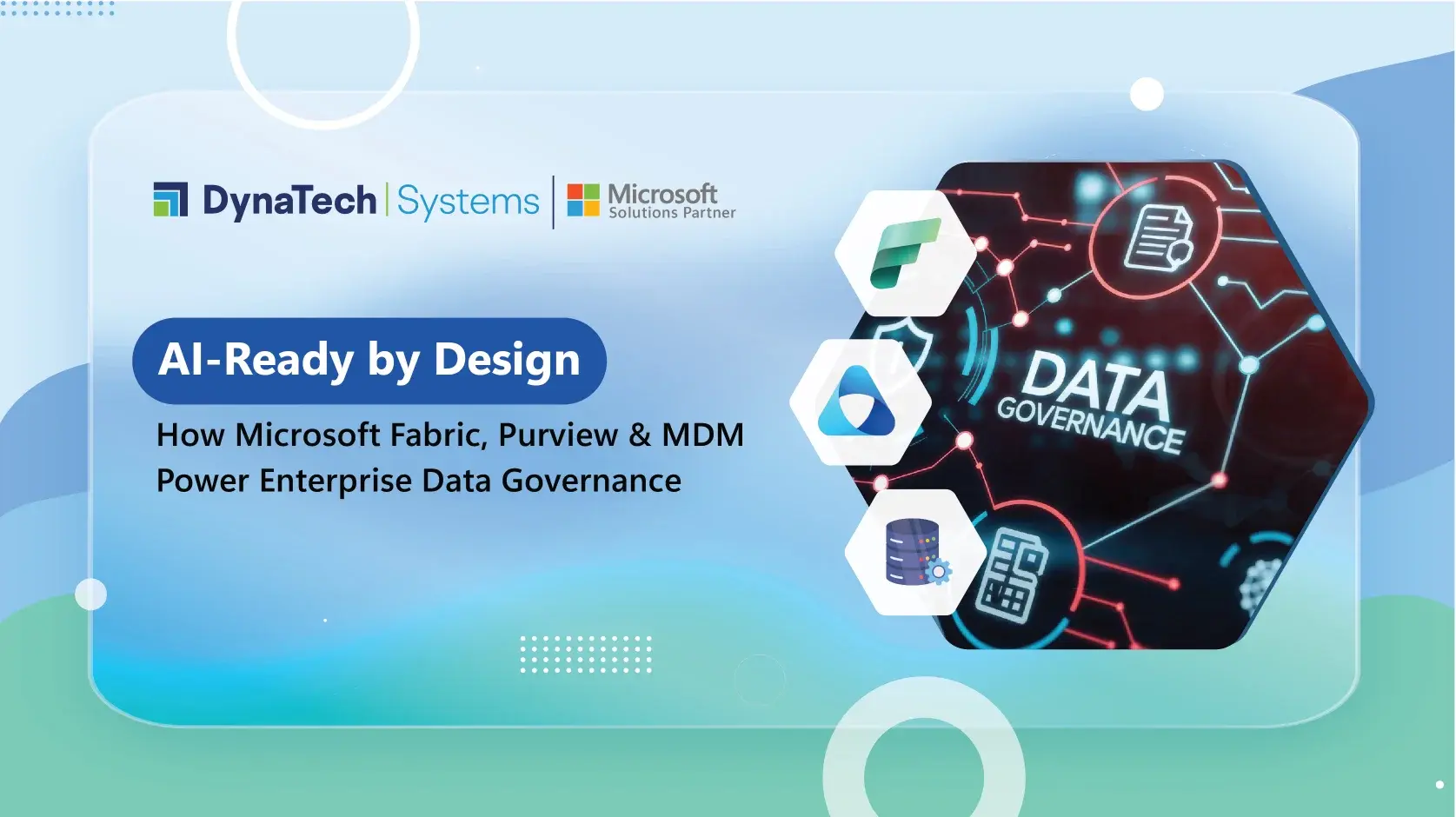
AI is no longer constrained by algorithms; it's constrained by data trust. AI data governance is the discipline of making sure AI-ready data refers to the data that is classified, lineage-tracked, and consistently defined. It is what actually feeds your models, rather than whatever happens to be sitting in a lake or warehouse.
As enterprises accelerate investments in Microsoft Fabric AI, Generative AI, and advanced analytics, the real differentiator is whether their data is governed and decision- ready. This is where Microsoft Fabric, Microsoft Purview, and Master Data Management (MDM) converge to form a governance-first architecture for AI at scale.
At DynaTech, we see this shift daily: organizations moving from fragmented controls to an integrated data governance fabric that enables innovation without compromise. The future of AI belongs to enterprises that treat data governance not as compliance—but as strategy.
This is exactly where DynaTech helps enterprises architect AI-ready data foundations on Microsoft Fabric.
Why Traditional Data Governance No Longer Works for AI
AI Moves Faster Than Governance
Data governance was designed for control.AI is designed for speed.
When AI in Microsoft Fabric enters the picture, data flows continuously. That too across domains, tools, and teams. Static governance models can’t keep up.
Visibility Breaks First
Once Microsoft Fabric machine learning pipelines and generative AI workloads go live, basic questions become hard to answer.
-
Where did the data come from?
-
Who touched it last?
-
Which model used it?
-
Without real-time lineage, governance becomes guesswork.
Fragmented Ownership Becomes Risk
-
Policies live with security teams.
-
Data pipelines live with engineering.
-
Business logic lives inside reports.
AI ignores these boundaries.
The gaps between teams turn into operational and compliance risks.
No Master Data, No Trust
AI outputs are only as reliable as the data they learn from.
When customer, product, or vendor data lacks consistency, AI produces confident answers. But these answers are built on shaky ground.
This is where Master Data Management (MDM) becomes non-negotiable.
Governance Must Live Inside the Platform
AI-ready governance cannot sit outside analytics anymore.
It must be embedded into Microsoft Fabric AI itself.
Automated. Continuous. Scalable.
Master Data Management for AI brings order where AI demands consistency Master Data Management (MDM) is what helps models avoid conflicts in version of each other
DynaTech helps enterprises modernize data for AI. We align Fabric, Purview, and MDM into one operational model.
Microsoft Fabric Is the AI Operating Layer—Not Just an Analytics Platform
Fabric Changes the Role of Data
-
Microsoft Fabric isn’t another analytics tool.
-
It’s where data engineering, analytics, and AI workloads converge.
-
Pipelines, notebooks, lakehouses, and models now live in one ecosystem.
That convergence changes everything.
AI Runs Where the Data Lives
With Microsoft Fabric AI, models are no longer built in isolation.
-
They learn directly from enterprise data.
-
They evolve continuously.
-
They influence decisions in near real time.
Governance cannot be bolted on later.
Generative AI Raises the Stakes
Microsoft Fabric generative AI introduces a new challenge.
-
Data isn’t just analyzed.
-
It’s interpreted.
-
Summarized.
Turned into language that executives act on.
If the underlying data is incomplete or misclassified, AI doesn’t hesitate.
It responds with confidence.
Machine Learning at Scale Needs Control
Microsoft Fabric machine learning enables rapid experimentation.
That speed is powerful. But it’s also dangerous without guardrails.
- Models must inherit the same governance rules as the data itself.
- Access. Sensitivity. Lineage. Usage context.
- Anything less creates blind spots.
Microsoft Fabric data governance can't be an afterthought bolted onto this layer. It must be built into it, which is exactly the gap Microsoft Purview is designed to close
Microsoft Purview Becomes the Governance Brain in an AI-Ready Fabric Architecture
Governance Needs Intelligence, Not Just Policies
-
AI-scale environments don’t fail because rules are missing.
-
They fail because rules aren’t enforced where data is actually used.
-
Microsoft Purview shifts governance from documentation to execution.
Purview Sees What AI Sees
As data flows through Microsoft Fabric, Purview tracks it automatically.
-
Across lakehouses.
-
Across pipelines.
-
Across analytics and AI workloads.
Lineage is no longer retrospective.
It’s continuous.
In plain terms, data lineage for AI means being able to trace any output — a forecast, a summary, a recommendation back through every table, pipeline, and transformation that shaped the data behind it.
Purview builds this automatically by scanning connected Fabric workspaces, capturing lineage down to individual tables and, for Lakehouse data, down to the column level.
That matters when AI models learn and relearn from the same data.
Classification Is the Foundation
AI does not understand sensitivity.
Purview does.
-
With automated data classification, sensitive data is identified early.
-
Personally identifiable information.
-
Financial records.
-
Regulated attributes.
Those labels follow the data into Microsoft Fabric AI and machine learning models.
How Microsoft Fabric Purview Integration Actually Works
Microsoft Fabric Purview integration isn't a manual export-import process. It's a connected scan.
Purview registers your Fabric tenant or workspace as a data source.
It scans automatically — lakehouses, warehouses, pipelines, semantic models, and KQL databases. Item-level metadata and lineage come back for nearly everything. For Lakehouse tables, column-level metadata comes back too.
One caveat worth knowing: automatic classification, the part that detects PII or financial data without a human tagging it — isn't yet available for Fabric-native items the way it is for SQL databases or Azure Storage.
Sensitive Fabric data still needs a classification pass, manual or scripted, before Purview's policies can act on it.
That single gap is worth planning around, not ignoring.
Policy Enforcement at the Point of Use
Traditional governance stops at access control.
Purview goes further.
-
Policies define who can see data.
-
Who can train models on it.
-
Which datasets are excluded from AI use entirely.
Governance decisions are enforced where AI runs. And not after insights are produced.
From Compliance to Confidence
Purview isn’t only about risk mitigation.
It’s about decision confidence.
-
Executives can trace AI-driven insights back to governed data sources.
-
Audit teams can explain how results were produced.
-
Data teams spend less time defending outputs, and more time improving them.
This is governance that keeps pace with Microsoft Fabric machine learning and generative AI.

Prepare Your Data for the Next AI Initiative
Before scaling AI, make sure your data is trusted, governed, and accessible. Discover the steps needed to build an AI-ready data foundation with Microsoft Fabric, Purview, and MDM.
Master Data Management Is the Anchor That Keeps AI Grounded
AI Amplifies Data Inconsistencies
AI doesn’t fix data problems.
It magnifies them.
-
Duplicate customers.
-
Conflicting product hierarchies.
-
Unclear vendor definitions.
When these issues feed AI models, outputs look polished. But, they tell different stories.
MDM Creates a Single Point of Truth
Master Data Management (MDM) brings order where AI demands consistency.
-
One customer definition.
-
One product structure.
-
One vendor record.
This consistency becomes the reference point for Microsoft Fabric AI workloads.
AI Learns from What You Standardize
Models trained on fragmented master data behave unpredictably.
Models trained on governed master data behave responsibly.
MDM ensures AI learns from data that is validated, and approved before it ever reaches a model.
Fabric Needs MDM to Scale Responsibly
Microsoft Fabric machine learning makes experimentation easy.
MDM makes scaling safe.
Without master data controls, insights vary by dataset.
With MDM, analytics and AI speak the same language across the enterprise.
Where DynaTech Adds Value
At DynaTech, we don’t treat MDM as a standalone system.
-
We embed it into Fabric architectures.
-
Aligned with Microsoft Purview policies.
-
Integrated with analytics and AI pipelines.
This is how AI remains explainable as it scales.
How Fabric, Purview, and MDM Work Together to Create AI-Ready Data
Three Capabilities. One Operating Model
Individually, each tool solves a problem.
Together, they change how data supports AI.
-
Microsoft Fabric moves and analyzes data.
-
Microsoft Purview governs it.
-
MDM stabilizes it.
AI depends on all three; at the same time.
Fabric Orchestrates the Flow
-
Fabric becomes the execution layer.
-
Data is ingested and transformed.
-
It’s consumed by analytics, machine learning, and generative AI.
This is where AI interacts with enterprise data every day.
Purview Governs in Motion
As data flows through Fabric, Microsoft Purview stays attached.
-
Lineage updates automatically.
-
Sensitivity labels persist.
-
Policies follow the data into AI workloads.
Governance doesn’t slow pipelines.
It moves with them.
MDM Anchors Meaning
-
MDM provides the reference point.
-
Customer means the same thing everywhere.
-
Product hierarchies stay consistent.
-
Vendor data aligns across systems.
AI models trained on this data produce insights that align across teams.
What This Looks Like in Practice
-
A governed dataset enters Fabric.
-
Purview classifies and enforces usage rules.
-
MDM ensures entities are standardized.
-
AI models consume trusted data. And that too, without manual intervention.
This is how AI in Microsoft Fabric becomes repeatable and not experimental.
From Architecture to Advantage
-
This convergence turns governance into an enabler.
-
Faster model deployment.
-
Fewer compliance surprises.
-
Higher confidence in AI-driven decisions.
It’s not about control.
It’s about scale without chaos.
Not Sure Where to Start with AI Data Governance?
From data quality and master data to lineage, security, and compliance, our experts can help you identify the right governance approach for your AI initiatives.
Conclusion: AI Readiness Is a Data Leadership Decision
AI strategy doesn’t start with models.
It starts with discipline.
Enterprises that succeed with AI are not the ones moving fastest.
They are the ones moving deliberately—on data they understand, govern, and trust.
Microsoft Fabric, Microsoft Purview, and Master Data Management create that discipline when they are designed to work together. Not as tools. As an operating model. One that allows AI in Microsoft Fabric to scale without eroding accountability.
This is where governance becomes a competitive advantage.
And where leadership stops asking whether AI is ready—because the data already is.
If your organization is preparing for enterprise-scale AI, DynaTech, as a Microsoft Solutions Partner, helps design AI-ready data governance on Microsoft Fabric built for trust, scale, and long-term impact. Talk to our data and AI experts today.
Frequently Ask Question