 18 Jun 2026
A Dynamics 365 update should not create uncertainty across enterprise operations.
Yet many organizations continue to experience broken workflows, unstable regression scripts, delayed deployments, and growing QA cycles after even minor changes across D365 Sales, Customer Service, and Power Platform environments. The issue is no longer Dynamics 365 itself. It is that many traditional testing frameworks were designed for slower release cycles and relatively stable applications.
Today's Customer Engagement ecosystems are far more dynamic. AI copilots, Power Platform customizations, third-party integrations, and continuously evolving business processes have made static automation models increasingly difficult to sustain. Even small changes can trigger failures across interconnected workflows, creating additional maintenance overhead and slowing release confidence.
As a result, enterprises are rethinking D365 CE test automation and turning to AI-driven testing frameworks that offer greater adaptability, resilience, and long-term sustainability. At DynaTech, we are seeing organizations move beyond conventional CRM testing approaches and embrace intelligent automation strategies built for modern Dynamics 365 environments.
Why Conventional D365 CE Test Automation Falls Short in Modern Environments
Microsoft Dynamics 365 Customer Engagement solutions no longer operate as standalone CRM systems.
Enterprise deployments now extend across D365 Sales workflows, Customer Service operations, Power Platform integrations, AI copilots, mobile field operations, customer portals, and third-party APIs. Every new integration increases testing complexity.
This is where traditional D365 CE test automation frameworks begin to struggle.
Many automation models still rely on fixed locators, rigid execution paths, and script-heavy validation logic. While effective in controlled environments, they become difficult to sustain as Dynamics 365 ecosystems evolve continuously.
A small UI change inside Dynamics 365 Sales automated testing workflows can disrupt multiple regression scenarios. Updates to routing logic inside Dynamics 365 Customer Service testing environments may trigger failures across interconnected workflows and integrations.
The challenge is not automation itself. It is that many testing strategies were built for relatively stable applications, while modern Dynamics 365 environments change constantly through release updates, AI-assisted workflows, and cross-platform integrations.
This is why enterprises are rethinking automated software testing services around adaptability, resilience, and long-term automation sustainability.
How AI Test Automation Brings Resilience to Dynamics 365 Testing
AI test automation introduces a fundamentally different approach to enterprise QA.
Instead of depending entirely on static scripts and fixed execution logic, intelligent automation frameworks use machine learning, adaptive element recognition, self-healing automation models, and contextual validation techniques to improve test resilience.
For D365 test automation environments, this becomes especially valuable because Dynamics 365 applications frequently evolve through:
- UI updates
- Business rule changes
- Workflow modifications
- Power Platform integrations
- Microsoft release updates
- Role-based personalization
Traditional automation scripts often require manual updates after these changes occur. Intelligent test automation frameworks reduce that dependency by identifying interface variations dynamically and adjusting execution paths automatically.
This significantly improves regression stability.
AI-powered automation can also accelerate test creation by identifying reusable workflows, recommending validation paths, and detecting high-risk operational scenarios based on application behavior within an AI-ready data platform for Microsoft Dynamics 365.
Instead of spending large amounts of time maintaining brittle automation scripts, QA teams can focus more on improving test coverage, validating business outcomes, and strengthening release confidence.
For enterprises managing large Dynamics 365 Customer Engagement ecosystems, this operational shift can reduce both testing bottlenecks and long-term automation maintenance costs.
Challenges in Dynamics 365 Sales and Customer Service Testing
As Dynamics 365 Customer Engagement environments become more interconnected, maintaining reliable testing across Sales and Customer Service workflows is becoming increasingly challenging.
D365 Sales Testing Challenges
D365 Sales environments have evolved far beyond traditional CRM workflows. Forecasting, CPQ, approval automation, AI recommendations, and Power Platform integrations now operate together, increasing testing complexity.
Even small workflow changes can affect pricing, approvals, forecasting, and connected processes. As release cycles accelerate, enterprises need Dynamics 365 Sales automated testing approaches that can adapt to continuously evolving workflows and interconnected systems.
At DynaTech, we help organizations strengthen Dynamics 365 Sales and test automation strategies built for evolving Customer Engagement environments and continuous operational change.
Dynamics 365 Customer Service Testing Challenges
Customer service operations now span multiple channels, automation layers, and interconnected systems. Modern Dynamics 365 Customer Service testing environments often involve omnichannel interactions, AI-assisted experiences, automated case routing, chatbots, SLA validation, and escalation workflows.
Frequent changes to routing logic, service queues, forms, and workflows can create widespread regression issues, making manual testing and static automation frameworks increasingly difficult to maintain.
AI-powered D365 CE test automation improves adaptability and regression resilience by evaluating workflow behavior dynamically, detecting execution inconsistencies faster, and expanding coverage across connected service operations.
This becomes especially important for enterprises focused on Powering Dynamics 365 data insights with Microsoft Fabric to improve customer experience visibility, service quality, and operational efficiency.
Where AI Improves Dynamics 365 Customer Engagement Testing
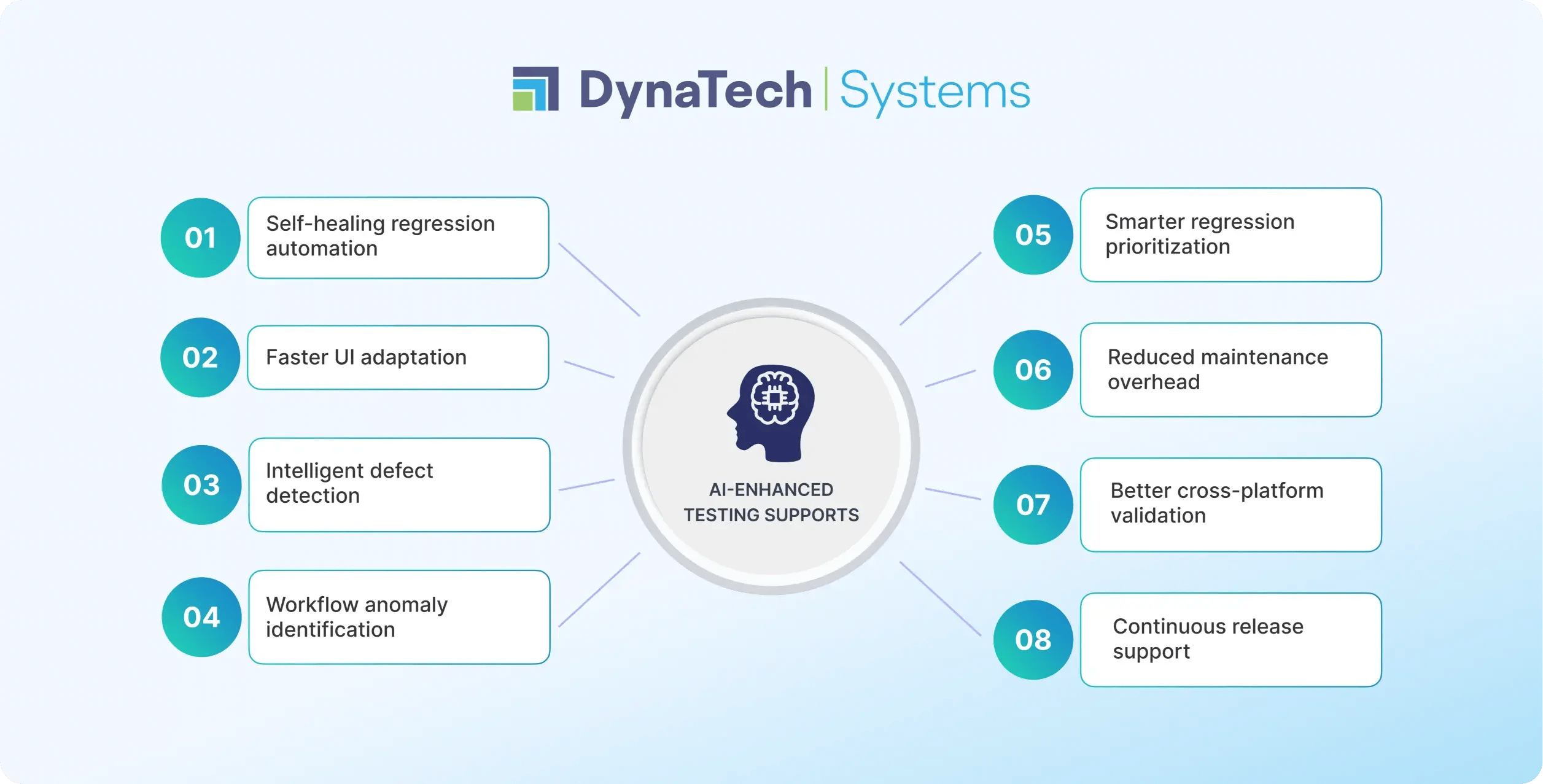
Why Intelligent Test Automation Is Becoming a Strategic Enterprise Priority
Testing is no longer treated as a final validation step before deployment.
In modern Dynamics 365 environments, testing directly affects release velocity, operational continuity, customer experience consistency, and enterprise scalability. A failed deployment today can disrupt sales workflows, delay customer service operations, interrupt field execution processes, and create downstream business instability across interconnected systems.
That pressure is growing as enterprises continue expanding AI copilots, Power Platform automation, low-code applications, customer engagement workflows, and third-party integrations across Dynamics 365 ecosystems.
The challenge is that many traditional automation frameworks were built around relatively stable applications and predictable release cycles. Modern enterprise environments no longer operate that way.
Applications evolve continuously through workflow changes, interface updates, integration modifications, security adjustments, and business process customization, increasing the importance of strong Dynamics 365 data governance best practices across enterprise environments. Maintaining large script-heavy regression frameworks under these conditions often creates growing maintenance overhead, unstable automation coverage, and slower deployment cycles.
This is why intelligent test automation is becoming a strategic priority across enterprise Dynamics 365 programs.
What Enterprises Expect from Modern Test Automation
Businesses are now prioritizing automation frameworks capable of:
- Supporting continuous release environments
- Adapting to changing workflows and interfaces
- Reducing regression maintenance effort
- Improving automation resilience
- Accelerating deployment confidence
- Scaling alongside operational complexity
Building Testing Ecosystems That Scale with the Business
The shift is no longer about simply increasing automation coverage.
It is about building testing ecosystems that can evolve with the business instead of slowing transformation initiatives down.
At DynaTech, as a Dynamics 365 partner, we help enterprises modernize D365 test automation through intelligent QA strategies designed for long-term scalability, release stability, and operational resilience across evolving Customer Engagement environments.
Building Smarter D365 CE Test Automation Strategies
Modern enterprise testing requires more than large regression libraries and static automation coverage.
It requires intelligent testing strategies capable of adapting alongside evolving Dynamics 365 Customer Engagement environments.
AI-powered automation is helping enterprises reduce maintenance complexity, improve regression resilience, and support faster release cycles across D365 Sales, Customer Service, and Field Service operations.
At DynaTech, we help organizations modernize enterprise QA through scalable D365 CE test automation strategies designed for long-term agility and operational stability. From AI-driven regression testing to intelligent automation optimization, our teams help enterprises strengthen release confidence across complex Dynamics 365 ecosystems.
Looking to modernize your Dynamics 365 testing strategy? Connect with DynaTech to explore AI-powered automation frameworks built for modern Customer Engagement operations.