.webp)
 12 Jun 2026
Introduction
With the announced RSAT deprecation 2027, many organizations are re-evaluating their Dynamics 365 testing automation strategy. For years, Microsoft Dynamics 365 teams have relied on the Regression Suite Automation Tool (RSAT) to automate user acceptance testing, validate business processes, and reduce the risks associated with updates and customizations. RSAT helped organizations move beyond manual testing and establish repeatable testing practices across Dynamics 365 Finance and Operations environments.
Now, that chapter is coming to an end.
Microsoft has announced that RSAT will be deprecated in May 2027, giving organizations a limited window to rethink their testing strategies and identify a future-ready alternative. While the announcement may seem distant, enterprises with hundreds of business processes, frequent releases, and complex customizations cannot afford to wait until the last minute. The decisions made today will determine how smoothly testing operations continue after RSAT reaches end-of-life.
Microsoft's RSAT Deprecation Announcement: What We Know
The Regression Suite Automation Tool (RSAT) was designed to help Dynamics 365 Finance and Operations users automate business process testing. It also doesn’t need deep coding. Using Task Recorder and Azure DevOps integration, enterprises could create, execute, and manage regression tests efficiently.
Microsoft has now confirmed plans to retire RSAT by May 2027. They have signaled a wider shift toward modern testing. It will align with cloud-first, AI-enabled, and continuously evolving business applications.
For D365 customers, the message is clear:
- Existing RSAT investments remain usable until retirement.
- Long-term testing strategies should no longer rely on RSAT.
- Organizations need to evaluate replacement solutions before migration timelines become compressed.
- Future testing frameworks must support scalability, intelligence, and reduced maintenance effort.
Why RSAT Became Popular in the First Place
Before discussing replacement options, it's important to understand why RSAT was widely adopted.
RSAT helped organizations:
|
Capability |
Business Benefit |
|
Task Recorder Integration |
Record business processes without coding |
|
Automated UAT Testing |
Minimize manual testing effort |
|
Azure DevOps Integration |
Centralized test management |
|
Regression Testing |
Validate updates before deployment |
|
Excel-Based Parameters |
Simplified test execution |
Microsoft itself positioned RSAT as a tool to reduce the time and cost related to User Acceptance Testing (UAT) in D365 F&O environments.
For many organizations, RSAT became a dependable testing companion during implementation projects, upgrades, and release cycles.
However, business requirements have changed significantly since RSAT's introduction.
The Problem: Modern Testing Requirements Have Outgrown RSAT
The biggest challenge is not that RSAT is disappearing.
The bigger challenge is that many organizations still depend on a testing approach built for a different era.
Today's Dynamics 365 environments are:
- Updated more frequently
- Integrated with multiple applications
- Powered by AI capabilities
- Customized across departments
- Connected to Power Platform solutions
- Dependent on continuous delivery models
Testing frameworks now need to move at the same speed as innovation.
Unfortunately, traditional automation approaches often struggle to keep up.
Key Limitations of RSAT in Modern Dynamics 365 Environments
1. High Test Maintenance Effort
One of the most common challenges with traditional UI-driven automation is maintenance.
Even small interface changes can require updates to test scripts, recordings, or automation assets.
As Dynamics 365 environments continue evolving through Microsoft's release waves, maintaining large RSAT libraries can become increasingly resource-intensive.
2. Limited Intelligence
RSAT executes predefined test paths.
It does not understand application behavior, business context, or process intent.
This means testing teams must manually identify failures, investigate root causes, and continuously update automation assets.
Modern testing platforms are increasingly expected to provide:
- Self-healing capabilities
- Intelligent failure detection
- Automated recommendations
- AI-assisted test creation
3. Scaling Challenges
Organizations running:
- Multiple legal entities
- Global deployments
- Hundreds of workflows
- Frequent release cycles
often find that traditional test management approaches become difficult to scale efficiently.
4. Heavy Dependency on Recordings
RSAT relies heavily on Task Recorder-generated assets. While this approach simplified initial automation, it can create long-term maintenance overhead when business processes change frequently.
5. Lack of AI-Driven Testing Capabilities
Perhaps the biggest limitation is that RSAT was built before the rise of AI-powered testing.
Today's enterprises want testing platforms that can:
- Develop test scenarios automatically
- Identify impacted business processes
- Predict risk areas
- Decrease manual intervention
- Accelerate release validation
These capabilities have become very essential as organizations pursue faster digital transformation.
The Business Risks of Waiting Until 2027
Many organizations may view May 2027 as a distant deadline.
That mindset creates risk.
Consider what needs to happen before a successful migration:
Assessment Phase
- Inventory existing RSAT assets
- Identify business-critical test cases
- Review testing coverage
Evaluation Phase
- Compare replacement solutions
- Conduct proof-of-concepts
- Validate scalability
Migration Phase
- Convert existing test libraries
- Train users
- Establish governance
Optimization Phase
- Improve automation coverage
- Reduce maintenance effort
- Introduce AI capabilities
For enterprises with hundreds or thousands of test cases, this transition could take months.
Waiting until the final year may result in rushed decisions, increased costs, and operational disruption.
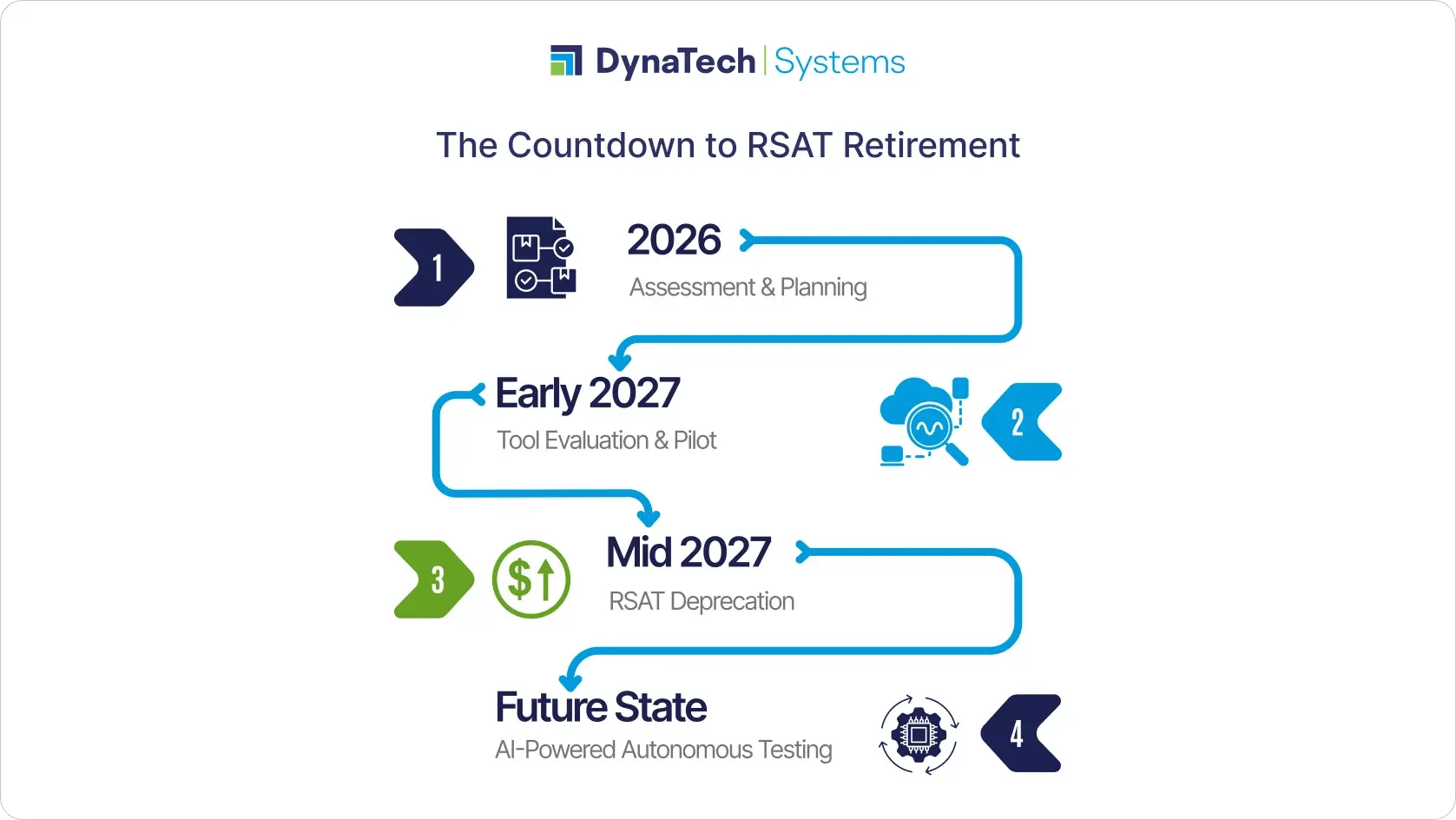
Why AI-Driven Testing Is Becoming the New Standard for Dynamics 365 Testing Automation
Software testing is experiencing the same transformation that AI has brought to customer service, analytics, and software development.
Instead of simply automating clicks and validations, modern testing platforms are becoming intelligent.
Traditional Automation
- Script creation
- Manual maintenance
- Fixed execution paths
- Reactive testing
AI-Powered Automation
- Intelligent test generation
- Self-healing automation
- Smart impact analysis
- Predictive quality insights
- Faster release validation
Industry analysts increasingly identify AI-assisted testing as a critical capability for organizations pursuing continuous delivery and rapid software innovation.
The objective is no longer just automation. The objective is autonomous quality assurance.
Organizations evaluating their next testing platform can also explore our detailed comparison of AI Testing vs RSAT for Dynamics 365 to understand the differences in maintenance, scalability, and intelligence.

Still Relying on RSAT for Dynamics 365 Testing?
The 2027 deadline is closer than it appears when testing libraries, release cycles, and migration planning are taken into account.
What Should Organizations Look for in an RSAT Replacement?
Not every automation platform is designed specifically for Dynamics 365.
When evaluating alternatives, organizations should prioritize:
|
Requirement |
Why It Matters |
|
AI-Powered Automation |
Reduces maintenance effort |
|
Dynamics 365 Focus |
Faster adoption and accuracy |
|
Scalability |
Supports enterprise growth |
|
Self-Healing Tests |
Minimizes script failures |
|
Low-Code Approach |
Enables business users |
|
Continuous Testing |
Supports frequent releases |
|
Advanced Reporting |
Improves decision-making |
|
Cloud-Native Architecture |
Future-ready operations |
The goal should not simply be replacing RSAT.
The goal should be modernizing the entire testing strategy.
DynaTech's AI-Powered Testing Platform: A Future-Ready Alternative to RSAT
As Dynamics 365 environments become increasingly complex, organizations need more than a direct RSAT substitute.
They need a platform built for the next generation of enterprise testing.
DynaTech's AI-powered automation testing solution is designed specifically to help organizations move beyond the limitations of traditional testing frameworks.
What Makes It Different?
AI-Driven Test Creation
Reduce test creation effort, accelerate automation coverage, and shorten the time required to validate business-critical processes.
Intelligent Automation
Detect application changes faster, reduce test failures, and improve overall testing reliability across Dynamics 365 environments.
Reduced Maintenance
Reduce test maintenance effort, lower operational overhead, and improve release cycle efficiency.
Enterprise Scalability
Enable consistent testing across multiple business units, legal entities, and global deployments without increasing testing complexity.
Faster Release Readiness
Accelerate release validation, reduce deployment risks, and improve confidence in every Dynamics 365 update.
Dynamics 365 Expertise
Built on deep experience delivering Microsoft Dynamics 365 solutions across industries and complex enterprise environments.
Rather than simply replacing RSAT functionality, the platform helps organizations modernize how quality assurance is performed.
Preparing for the Post-RSAT Era: Your Action Plan
Enterprises should begin taking action now:
Step 1: Audit Existing RSAT Assets
Identify business-critical tests and other gaps.
Step 2: Assess Maintenance Costs
Understand how much effort is currently spent maintaining automation.
Step 3: Define Future Testing Requirements
Consider AI, scalability, integrations, and release frequency.
Step 4: Evaluate Modern Alternatives
Go beyond traditional automation frameworks.
Step 5: Start Pilot Programs Early
Avoid last-minute migrations by validating replacement solutions now.
Conclusion
RSAT played an important role in helping D365 teams automate testing and improve release confidence. Its contribution to reducing manual testing effort and supporting user acceptance testing cannot be overlooked.
However, Microsoft's planned RSAT deprecation in May 2027 marks more than the retirement of a testing tool. It signals a shift toward a new generation of intelligent testing platforms.
Organizations that start planning today will have the flexibility to evaluate options, modernize testing processes, and adopt AI-driven automation on their own timeline. Those that delay may find themselves facing compressed migration schedules, increased operational risks, and missed opportunities to improve testing efficiency.
Ready to Move Beyond RSAT?
As a premier Microsoft Solutions Partner, DynaTech helps organizations prepare for the post-RSAT era with AI-powered testing automation tool designed specifically for Microsoft Dynamics 365 environments. Whether you're evaluating an RSAT replacement, planning a migration strategy, or looking to modernize your testing framework, our experts can help create a roadmap that reduces risk and accelerates quality assurance outcomes.