Choosing an ERP model involves more than selecting the right software. For businesses managing multiple entities, the decision can have a direct impact on costs, integrations, and how well different operations work together. While a single ERP system offers greater consistency, a best-of-breed approach allows businesses to choose specialized solutions for specific needs. This guide compares both approaches across total cost of ownership, integration, and governance to help you understand the trade-offs and choose what works best for your organization.
Quick Answer: Dynamics 365 vs. Best-of-Breed ERP
For multi-entity organizations, Dynamics 365 is generally the better choice as a core ERP, particularly when standardization, financial consolidation, governance, and connected business processes are priorities. A best-of-breed approach can be better when a specialized application delivers capabilities that a core ERP cannot match, or that create significant business value.
The practical choice does not have to be either-or. Many organizations can use Dynamics 365 Finance and Supply Chain Management as the ERP backbone and connect selected best-of-breed applications where specialization is needed.
Key Takeaways
- Dynamics 365 provides a broad ERP foundation for finance, supply chain, operations, and multi-entity management.
- Best-of-breed ERP strategies prioritize specialized applications, but they can increase integration and governance requirements.
- ERP total cost of ownership includes implementation, integration, data management, training, support, upgrades, and governance, not only licensing.
- A hybrid ERP architecture can combine Dynamics 365 standardization with specialist applications where they provide measurable value.
What Is a Best-of-Breed ERP Strategy?
A best-of-breed ERP strategy uses specialized applications for specific business functions instead of depending on a single ERP platform for every requirement. An enterprise might use one system for core finance, another for warehouse management, another for planning, and additional applications for eCommerce or industry-specific processes.
The main highlight is specialization. A dedicated application may offer deeper features for a particular process than a broader ERP platform.
The trade-off is architectural complexity. Each application introduces another vendor, source of data, integrations, security model, upgrade cycle, and support relationships. For multi-entity organizations, such different dependencies can be extremely important as operations expand across countries, subsidiaries, and business units.
Dynamics 365 vs. Best-of-Breed ERP: Key Differences
If you are looking for the best model for your organization, you have much more on the plate to evaluate. It completely depends upon what your business firm actually needs. Dynamics 365 typically favors standardization and connected processes, while best-of-breed environments prioritize specialized functionality. The ERP vs. best-of-breed decision therefore depends less on which model offers more features and more on where the business needs consistency versus specialization.
|
Factor |
Dynamics 365 |
Best-of-Breed |
|
TCO |
More centralized platform costs |
Multiple application and integration costs |
|
Integration |
Broad native ecosystem |
More point-to-point or middleware integration |
|
Governance |
More centralized |
Requires cross-system governance |
|
Flexibility |
Configurable and extensible |
High functional specialization |
|
Standardization |
Great fit for common processes |
Can vary by application |
|
Specialized functionality |
Broad capabilities |
Stronger in selected niche areas |
No single ERP suite is best-in-class for every business function, which is one reason organizations continue to evaluate composable and best-of-breedsolutions. The decision, therefore, should be based on operating requirements rather than assuming that either model is superior.
What Is Included in ERP Total Cost of Ownership?
ERP total cost of ownership extends well beyond software licensing. Organizations should evaluate the complete cost of operating the ERP architecture throughout its lifecycle.
Key cost categories include:
- Implementation: Consulting, configuration, customization, testing, and deployment.
- Integration: APIs, middleware, development, monitoring, and ongoing maintenance.
- Data management: Migration, cleansing, master data management, storage, and reporting.
- Training: User enablement, documentation, and change management.
- Support: Internal resources, managed services, vendor support, and issue resolution.
- Upgrades: Platform releases, regression testing, application updates, and remediation.
- Governance: Security, architecture standards, compliance, vendor management, and process ownership.
Microsoft's published pricing illustrates why license cost alone cannot determine TCO. Dynamics 365 Supply Chain Management is currently listed at $210 per user/month, while the Premium plan is $300 per user/month when paid annually. These are license prices, not the total cost of implementing and operating the solution.
As Aaron Feagler, Director of Security and Operations at Vera Bradley, told Microsoft, “Dynamics 365 has saved us millions of dollars a year in maintenance and software costs over the previous solutions.”
DynaTech can help organizations evaluate ERP TCO across licensing, implementation, integration, data, support, and long-term operational requirements before selecting an architecture.

Is Your ERP Cost Estimate Missing the Full Picture?
Licensing is only one line in the total cost of ownership. DynaTech reviews implementation, integration, data, support, and governance costs so you can compare architectures on equal terms.
How Does ERP Integration Change With Best-of-Breed Applications?
ERP integration becomes more complex when business processes are distributed across multiple applications. The challenge is not simply connecting systems. It is deciding which system owns which data and process.
An effective ERP integration strategy should define:
- Systems of record: Which application owns customers, products, vendors, orders, and financial data?
- Master data: How are common records created, validated, and synchronized?
- APIs and middleware: How will applications exchange data and handle failures?
- Data synchronization: Which information needs real-time, scheduled, or event-based updates?
- Integration ownership: Who monitors interfaces, resolves failures, and manages changes?
For example, an organization could use Dynamics 365 for Finance and Supply Chain while retaining a specialist warehouse or e-commerce application. That architecture can work well when data ownership and integration responsibilities are clearly defined.
DynaTech approaches ERP integration by mapping business processes, systems of record, data flows, and application responsibilities before connecting individual systems. This reduces the risk of creating integrations that work technically but lack clear operational ownership.
Which ERP Model Provides Better Governance and Standardization?
Dynamics 365 generally offers a simpler governance model when organizations want common processes across multiple entities. Standardized workflows, security policies, master data practices, and reporting structures can be managed around a common ERP foundation.
That matters when an organization operates across multiple legal entities. Microsoft Dynamics 365 Finance supports consolidation across legal entities, including scenarios involving different charts of accounts, fiscal calendars, reporting currencies, and elimination requirements.
A best-of-breed environment can still be governed effectively, but governance must span multiple platforms. This becomes particularly important in a multi-company ERP environment, where different entities may share core processes while still having their own operational requirements. IT and business teams need clear ownership for data, integrations, security, vendors, and application changes.
For organizations pursuing ERP consolidation in a multi-entity ERP environment, that additional governance effort should be included in the business case rather than treated as an implementation detail.
Hybrid ERP Architecture Approach
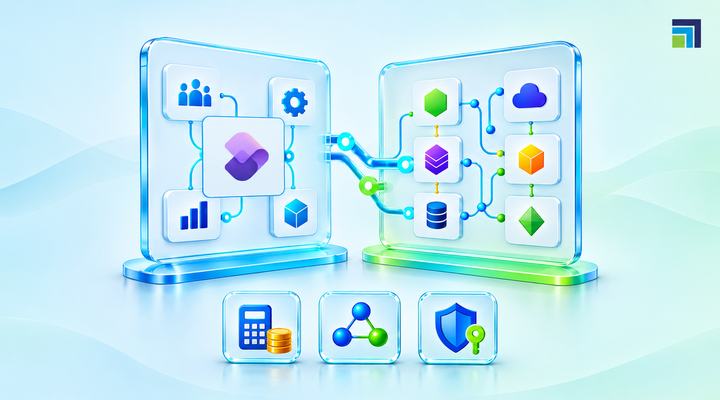
Yes. A hybrid ERP architecture can use Dynamics 365 as the core ERP while integrating best-of-breed applications where specialized capabilities provide clear business value.
For example:
Dynamics 365 Finance & Supply Chain Management → Core finance, procurement, inventory, and operations
Specialist applications → Advanced warehouse, e-commerce, planning, or industry-specific requirements
Microsoft Fabric / analytics → Enterprise reporting and data analysis
With this model, enterprises can smoothen their core processes without forcing every specialized requirement into the ERP.
The key is discipline. A best-of-breed application is used for clear functional or business advantages. Adding another application simply because it has a better feature list can cause unnecessary integration and governance costs.
DynaTech can help design such hybrid architecture by assessing existing applications, integration dependencies, data ownership, and future business needs.
Is Dynamics 365 the Right Choice for Multi-Entity Organizations?
For organizations managing multiple legal entities, subsidiaries, currencies, or operating regions, Dynamics 365 is a strong core ERP option. For companies evaluating an ERP for multiple entities, standardization and centralized governance are often key considerations.
Microsoft documents support for single-level and multilevel consolidations, multiple charts of accounts, different fiscal calendars, multiple reporting currencies, and eliminations in Dynamics 365 Finance. It can also consolidate balances from subsidiaries operating on different systems through import consolidation. Organizations evaluating multiple ERP platforms can also review our detailed ERP comparison for manufacturers.
The decision should still account for specialized requirements. If a best-of-breed application provides a capability that is strategically important and difficult to replicate, keeping it may make sense.
The strongest architecture is therefore often Dynamics 365 at the core, with selective specialization around it.
Conclusion
There is no universally correct answer to the ERP vs best-of-breed question. What matters is where your organization genuinely needs specialization and where standardization will reduce cost, risk, and reporting friction. Mapping systems of record, integration ownership, and governance responsibilities before selecting an architecture prevents most of the problems that surface later. Ongoing Dynamics 365 managed services can then keep that environment stable as entities, integrations, and reporting requirements change.