 07 Sep 2026
For a long time, engineering teams measured productivity by how quickly they could deliver new features. Today, another metric is becoming just as important: how confidently those features can be released.
GitHub Copilot has undoubtedly accelerated software development. Developers can generate methods, APIs, unit tests, and boilerplate code in a fraction of the time. Yet faster implementation has introduced a new engineering responsibility. Every AI-generated suggestion still needs to satisfy the same standards for quality, security, performance, and maintainability expected from manually written code.
This is where GitHub Copilot code quality becomes a practical engineering concern rather than just another AI capability. Enterprise applications operate within complex architectures, business rules, and governance requirements that extend well beyond code generation. AI may assist with implementation, but validating that implementation remains a responsibility shared across development, testing, and code review.
Organizations that recognize this distinction are using GitHub Copilot to accelerate delivery while strengthening the validation practices that keep software reliable in production through an Agentic DevOps with GitHub Copilot and Azure approach.
Where an AI Coding Assistant Creates the Greatest Engineering Value
Discussions around AI often focus on how quickly code can be generated. In practice, experienced development teams see value elsewhere.
An AI coding assistant delivers the greatest impact when it removes repetitive implementation work that consumes engineering time but contributes little strategic value. Boilerplate classes, API clients, validation methods, unit test scaffolding, configuration files, and documentation are all examples of tasks that follow recognizable patterns and can be accelerated without compromising engineering ownership.
This shift allows developers to spend more time on activities that genuinely require human expertise, including designing scalable architectures, solving business-specific problems, optimizing application performance, and reviewing complex implementations.
Rather than replacing developers, AI changes how engineering effort is distributed across the software development lifecycle.
Common areas where GitHub Copilot consistently improves AI developer productivity include:
- Generating repetitive methods and reusable components.
- Producing unit test templates for existing business logic.
- Creating API models and request structures.
- Refactoring repetitive code into cleaner implementations.
- Generating technical documentation and inline comments.
- Assisting developers working with unfamiliar frameworks or SDKs.
These improvements can significantly reduce development effort, particularly in enterprise projects where repetitive implementation work often consumes a considerable portion of each sprint.
However, organizations should resist measuring success solely by the number of lines of code generated. Faster development creates value only when the resulting code maintains the same quality standards expected from manually written software.
Why AI Code Quality Depends on Validation, Not Generation
One of the biggest misconceptions surrounding AI-assisted development is that generating code more quickly naturally leads to higher-quality software.
Enterprise engineering rarely works that way.
GitHub Copilot predicts code based on patterns learned from existing repositories and the context available within the current project, supporting Copilot-assisted Dynamics 365 plugin development. While those suggestions are often syntactically correct, they are not aware of an organization's business rules, regulatory obligations, architectural decisions, or operational requirements.
As a result, AI-generated code should always be treated as a proposed implementation rather than a production-ready solution.
This is where AI-powered code review becomes an essential part of modern software engineering, reinforcing the software quality assurance practices needed to maintain reliability and performance.
Instead of verifying whether code simply compiles, reviewers should evaluate whether the implementation satisfies functional requirements, follows established design patterns, aligns with organizational coding standards, and introduces no unnecessary security or performance risks.
A structured review typically focuses on several areas.
|
Validation Area |
Questions Engineering Teams Should Ask |
|
Business Logic |
Does the implementation solve the intended business problem correctly? |
|
Security |
Is authentication, authorization, and data validation handled appropriately? |
|
Performance |
Will the implementation remain efficient as transaction volumes increase? |
|
Maintainability |
Is the code readable, reusable, and aligned with existing coding standards? |
|
Architecture |
Does it follow established design principles and project conventions? |
This approach shifts code reviews away from identifying formatting inconsistencies and toward evaluating engineering decisions that directly influence long-term software quality.
For organizations adopting AI-assisted development at scale, validation becomes the mechanism that transforms rapid code generation into sustainable AI code quality.
Real-World GitHub Copilot Code Quality Validation in an Enterprise Project
Consider a developer building a new customer onboarding API.
Using GitHub Copilot, the initial service method, request model, and validation logic can often be generated within minutes. GitHub's own research puts the gain at up to 55% faster coding. From a productivity perspective, the task appears complete.
An experienced engineering team, however, views this as the beginning of the validation process rather than the end. Veracode's 2026 GenAI Code Security Report explains why: across more than 100 models, AI-generated code compiles at a syntax pass rate of roughly 100% but passes security testing only 56% of the time.
Before the code is approved, reviewers typically verify whether sensitive customer information is handled securely, exception handling follows organizational standards, logging supports operational troubleshooting, API responses remain consistent with existing services, and unit tests cover both expected and edge-case scenarios. Each check maps to a measured weakness: models pass log injection tasks just 12% of the time, and GitClear's analysis of 623 million code changes found a 47% rise in error-masking constructs and an 81% increase in duplicated code blocks.
In many cases, only a small portion of the generated code requires modification. Yet those refinements often determine whether the implementation remains reliable under real production workloads.
This is an important distinction. GitHub Copilot accelerates implementation, but engineering validation determines whether that implementation is ready for production. Google's DORA research describes the same pattern: the time AI saves in creation is frequently re-allocated to auditing and verification.
AI-Powered Code Review: Validating What GitHub Copilot Generates
Generating code is only one stage of software development. Verifying that the implementation behaves as intended remains equally important, regardless of whether the code was written manually or suggested by an AI model.
This is where AI agents in software testing are beginning to reshape quality assurance practices by supporting faster validation, smarter defect analysis, and more adaptive testing workflows.
Rather than replacing QA engineers, AI supports testing by accelerating activities that traditionally require significant manual effort. Developers can generate unit test templates, identify missing test scenarios, create mock data, and improve test coverage more efficiently than before. QA teams can also use AI to analyze regression failures, identify recurring defect patterns, and prioritize high-risk test cases.
Even with these capabilities, enterprise validation should continue to include multiple testing layers before deployment.
|
Testing Activity |
Purpose |
|
Unit Testing |
Verifies individual methods and business logic. |
|
Integration Testing |
Confirms interactions between applications, APIs, and databases. |
|
Regression Testing |
Ensures new code does not introduce unexpected failures. |
|
Performance Testing |
Validates application behavior under production-scale workloads. |
|
Security Testing |
Detects vulnerabilities before release. |
Organizations that integrate AI-powered code review into their engineering practices typically reduce validation effort while maintaining confidence in production releases. The objective is not to eliminate testing but to make testing more efficient without lowering quality standards.
Enterprise teams validating GitHub Copilot output alongside these layers often extend this coverage through Dynamics 365 QA testing services for full-stack quality assurance.
GitHub Copilot Best Practices for Enterprise Development Teams
Successful adoption of GitHub Copilot depends less on the tool itself and more on the governance surrounding its use. Organizations looking to scale these practices can further strengthen software delivery through Agentic DevOps with GitHub Copilot and Azure, where AI supports development, validation, and deployment across the DevOps lifecycle.
Engineering teams that establish clear development standards are generally more successful than those that treat AI as an unrestricted code generator. This is a discipline many organizations formalize through a testing center of excellence.
Several GitHub Copilot best practices have emerged across enterprise development environments.
- Use Copilot to accelerate repetitive implementation tasks rather than architectural design.
- Review every AI-generated suggestion through the same pull request process applied to manually written code.
- Validate generated logic against business requirements before approving changes.
- Maintain secure coding standards and avoid exposing confidential information through prompts.
- Continuously update coding guidelines so AI-generated contributions remain consistent with organizational development practices.
These practices ensure that AI improves engineering efficiency without introducing unnecessary technical debt or inconsistencies across the codebase.
Building an AI Development Workflow That Maintains Code Quality
Organizations often begin using AI at the individual developer level. Long-term success, however, depends on embedding AI into a standardized AI development workflow that balances productivity with governance. As a Microsoft Solutions Partner, DynaTech helps organizations establish these practices while integrating AI into modern software engineering workflows.
Instead of allowing every developer to adopt different review practices, mature engineering teams define a repeatable process that every AI-assisted contribution follows.
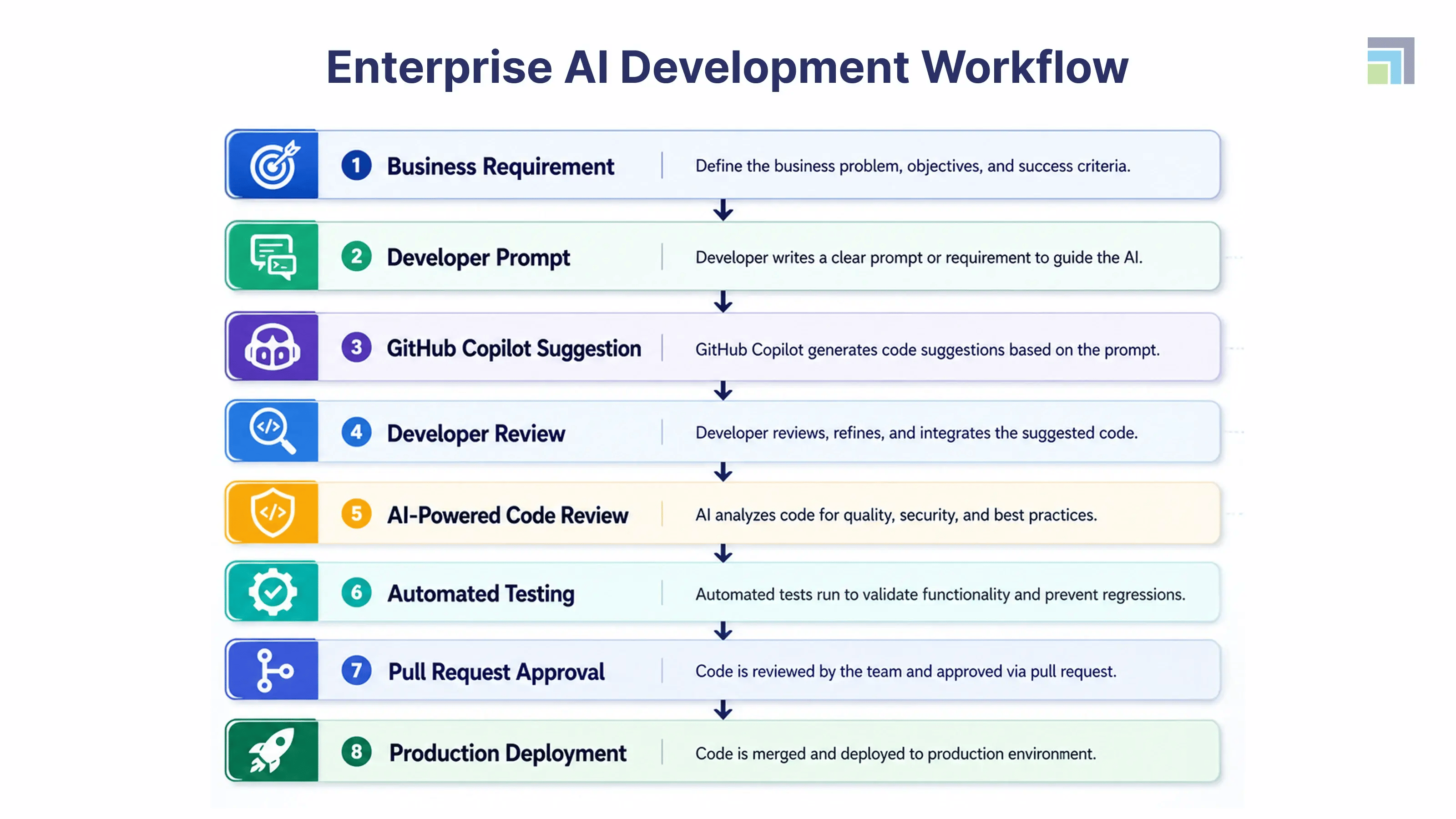
By integrating AI into an established workflow, organizations create consistent validation checkpoints without slowing development. Combining this approach with AI and ML-driven test automation helps engineering teams accelerate validation while maintaining software quality across every release.
This approach also makes it easier to measure improvements in both AI developer productivity and overall software quality.
Common Mistakes That Reduce AI Code Quality in Enterprise Projects
The effectiveness of AI-assisted development is often determined by how organizations use the technology rather than the technology itself. Many quality issues stem from weak engineering practices instead of limitations within GitHub Copilot.
The following mistakes are among the most common.
|
Common Mistakes |
Potential Business Impact |
|
Accepting AI-generated code without review |
Increased production defects |
|
Treating AI as an architectural decision-maker |
Inconsistent application design |
|
Skipping testing because code compiles |
Higher regression risk |
|
Writing vague or incomplete prompts |
Lower-quality recommendations |
|
Ignoring organizational coding standards |
Reduced maintainability |
|
Measuring success only by coding speed |
Technical debt over time |
These challenges reinforce an important principle. AI can accelerate software delivery, but only disciplined engineering practices can sustain AI code quality.

Better Code Starts with a Better Engineering Process
GitHub Copilot can accelerate development, but lasting improvements come from disciplined validation, automated testing, and modern DevOps practices. DynaTech helps organizations build software delivery processes that scale with confidence.
Conclusion: Faster Development Means Little Without Reliable Validation
GitHub Copilot has changed how software is written, but it has not changed what defines high-quality software.
Reliable applications are still built on sound architecture, thoughtful engineering decisions, disciplined code reviews, comprehensive testing, and a development culture that values long-term maintainability over short-term speed. AI simply enables those practices to happen more efficiently.
Organizations that realize the greatest return from AI-assisted development are not the ones generating the highest volume of code. They are the ones that have established clear validation frameworks around every AI-generated contribution. Every suggestion is reviewed, every implementation is tested, and every deployment is evaluated against the same engineering standards that existed before AI entered the workflow.
As the adoption of AI coding assistants continues to accelerate, the competitive advantage will no longer come from using AI itself. It will come from consistently transforming AI-generated code into production-ready software through disciplined engineering practices.
In the end, AI code quality is not determined when code is generated. It is determined when that code has been validated, trusted, and proven reliable in production.