 24 Aug 2026
A forecast becomes unreliable the moment business conditions change faster than the systems supporting it.
That is the reality many wholesale distributors face today.
Sales teams detect demand shifts before procurement teams see them. Warehouses struggle with fulfillment pressure while planners continue working with outdated inventory assumptions. Finance teams try to control carrying costs as operations react to uncertainty with excess stock and rushed purchasing decisions.
The challenge is no longer just supply chain disruption. Wholesale distributors are now managing volatile demand, multi-channel operations, tighter delivery expectations, and shrinking margins at the same time. Traditional wholesale distribution software was never designed for this level of operational complexity.
What businesses need now is a connected operating model where CRM, ERP, inventory, fulfillment, and AI-driven forecasting work together continuously.
This is where Dynamics 365 for wholesale and distribution is changing modern demand forecasting wholesale distribution operations. By unifying CRM, Finance & Operations, supply chain workflows, and AI-powered intelligence, Dynamics 365 helps distributors forecast demand more accurately, improve fulfillment agility, and make faster operational decisions with real-time visibility.
The Demand Forecasting Gap in Legacy Wholesale Distribution Software
Many legacy wholesale distribution software environments were never designed for real-time coordination across sales,
operations, and supply chain teams. Customer conversations sit inside CRM systems, inventory data lives in ERP platforms, and planners often rely on manually exported reports to make purchasing decisions.
The result is delayed visibility across the business.
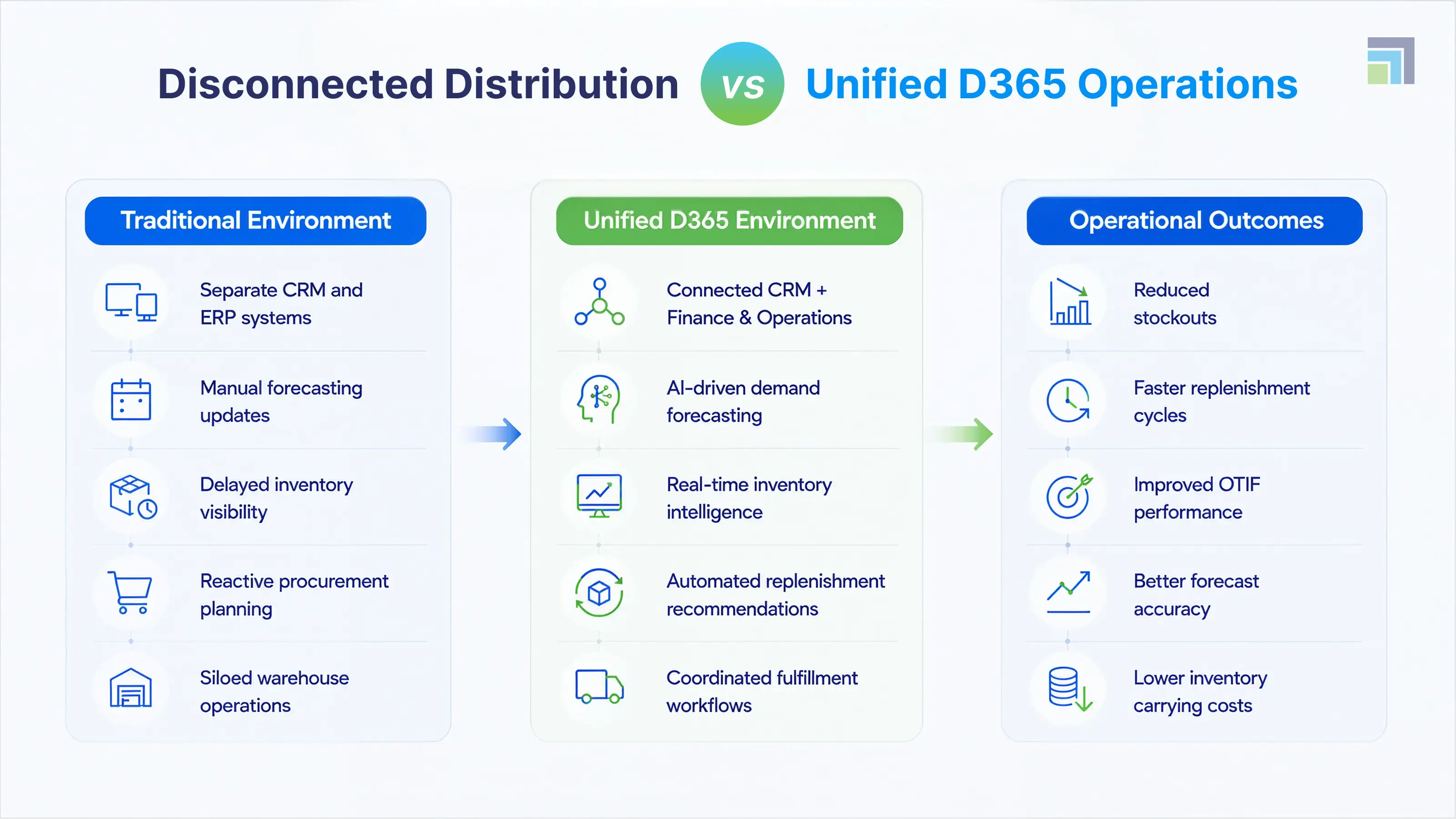
A sales team may identify rising demand from a major account while procurement teams continue ordering based on outdated projections. Warehouse teams may face stock shortages despite inventory existing elsewhere in the network. Finance teams struggle to balance carrying costs against uncertain replenishment cycles.
This fragmentation creates forecasting gaps that affect the entire distribution supply chain management process; one that strong supply chain management solutions are designed to close.
Traditional enterprise distribution software also relies too heavily on historical demand patterns. Historical data matters, but it does not capture sudden buying shifts, regional spikes, supplier delays, seasonal disruptions, or changing customer priorities. Forecasting models built only on past sales become increasingly unreliable in volatile markets.
Wholesale distributors managing multiple sales channels face even greater pressure. E-commerce orders, direct sales, dealer networks, retail partnerships, and field sales operations generate demand signals simultaneously. Without unified visibility, planners cannot accurately prioritize inventory allocation or fulfillment timing.
The operational impact becomes visible quickly:
- Overstocked slow-moving inventory
- Frequent stockouts for high-demand SKUs
- Partial order fulfillment
- Emergency procurement costs
- Missed delivery commitments
- Reduced customer satisfaction
In many organizations, the problem is not a lack of data. It is the inability to connect and operationalize it in real time.
How Dynamics 365 Creates a Unified Wholesale Distribution Ecosystem
Instead of operating through disconnected applications, Dynamics 365 for wholesale distribution connects sales, finance, inventory, procurement, warehousing, and fulfillment into a single operational environment. This unified structure allows distributors to respond faster to demand changes while improving forecasting accuracy and execution efficiency.
Centralized Customer and Demand Visibility
Dynamics 365 Sales, paired with CRM for wholesale distributors, captures customer interactions, buying trends, pipeline activity, and order history in real-time. These insights become immediately available to operations and planning teams, helping businesses identify demand shifts earlier.
Real-Time Inventory Intelligence
Dynamics 365 Finance & Operations provides live inventory visibility across warehouses, channels, and fulfillment centers. Teams can track stock availability, movement patterns, replenishment timelines, and allocation status without relying on delayed reports.
Connected Procurement and Supply Chain Planning
Procurement teams can align purchasing decisions with real-time demand signals instead of depending only on historical forecasting models. This reduces excess inventory, emergency purchasing, and replenishment delays.
Unified Order-to-Fulfillment Operations
From order creation to warehouse execution and delivery tracking, Dynamics 365 distribution management capabilities help businesses manage the entire fulfillment lifecycle through a connected workflow.
AI-Driven Operational Insights
By integrating AI, Power BI, and Microsoft Fabric capabilities, distributors gain access to predictive analytics, demand forecasting insights, inventory risk indicators, and operational performance visibility from a centralized platform.
Better Coordination Across Departments
Sales, finance, procurement, warehouse, and supply chain teams work from the same operational data. This minimizes communication gaps, improves decision-making speed, and strengthens cross-functional execution.
Scalability for Modern Distribution Models
Whether businesses operate through dealer networks, ecommerce platforms, retail partnerships, or multi-location warehouses, Dynamics 365 supports scalable ERP for wholesale distributors and wholesale distribution ERP environments without creating fragmented systems.
AI-Driven Demand Planning in Dynamics 365 for Wholesale Distributors
Forecasting accuracy, powered by AI capabilities in Dynamics 365, is becoming one of the most important AI demand planning advantages in wholesale distribution.
Modern demand planning software is no longer limited to generating projections from historical sales averages. AI-driven forecasting models inside Dynamics 365 Finance and Operations for wholesale industry environments continuously evaluate operational, transactional, and behavioral signals to improve planning accuracy.
This includes:
- Customer purchasing trends
- Seasonal demand patterns
- Supplier performance history
- Inventory turnover rates
- Lead-time variability
- Regional demand fluctuations
- Sales pipeline activity
- Product movement across channels
These insights help businesses forecast sales by city and product more accurately and make informed sales and inventory decisions.
AI-driven forecasting enables distributors to move beyond static monthly planning cycles. Demand sensing models can identify changes earlier and recommend adjustments before shortages or excess inventory affect operations.
For ERP for wholesale distributors, this capability becomes especially valuable when managing thousands of SKUs across multiple warehouses and fulfillment locations.
Instead of relying on manual forecasting assumptions, planners can use intelligent recommendations for procurement timing, inventory allocation, and replenishment prioritization. Dynamics 365 can also automate parts of the planning process using predictive analytics and machine learning models.
This reduces operational dependency on spreadsheets and disconnected planning tools.
The integration of Copilot and AI-based analytics further improves visibility by helping teams interpret forecasting data faster. Decision-makers can identify inventory risks, supplier delays, and fulfillment bottlenecks without manually consolidating reports from multiple systems.
The outcome is not simply better forecasting accuracy. It is a more responsive distribution operation capable of adapting to demand volatility without excessive inventory expansion.
How CRM and F&O Integration Improves Fulfillment Performance
Demand forecasting alone does not improve customer experience unless fulfillment operations can respond efficiently.
One of the biggest advantages of Dynamics 365 for wholesale distribution is the connection between customer-facing activity and operational execution.
In many traditional environments, sales teams commit delivery timelines without real-time inventory visibility. Operations teams then struggle to fulfill those commitments because warehouse capacity, stock availability, or procurement timelines were not aligned during the sales process.
A unified distribution supply chain management model changes that dynamic completely.
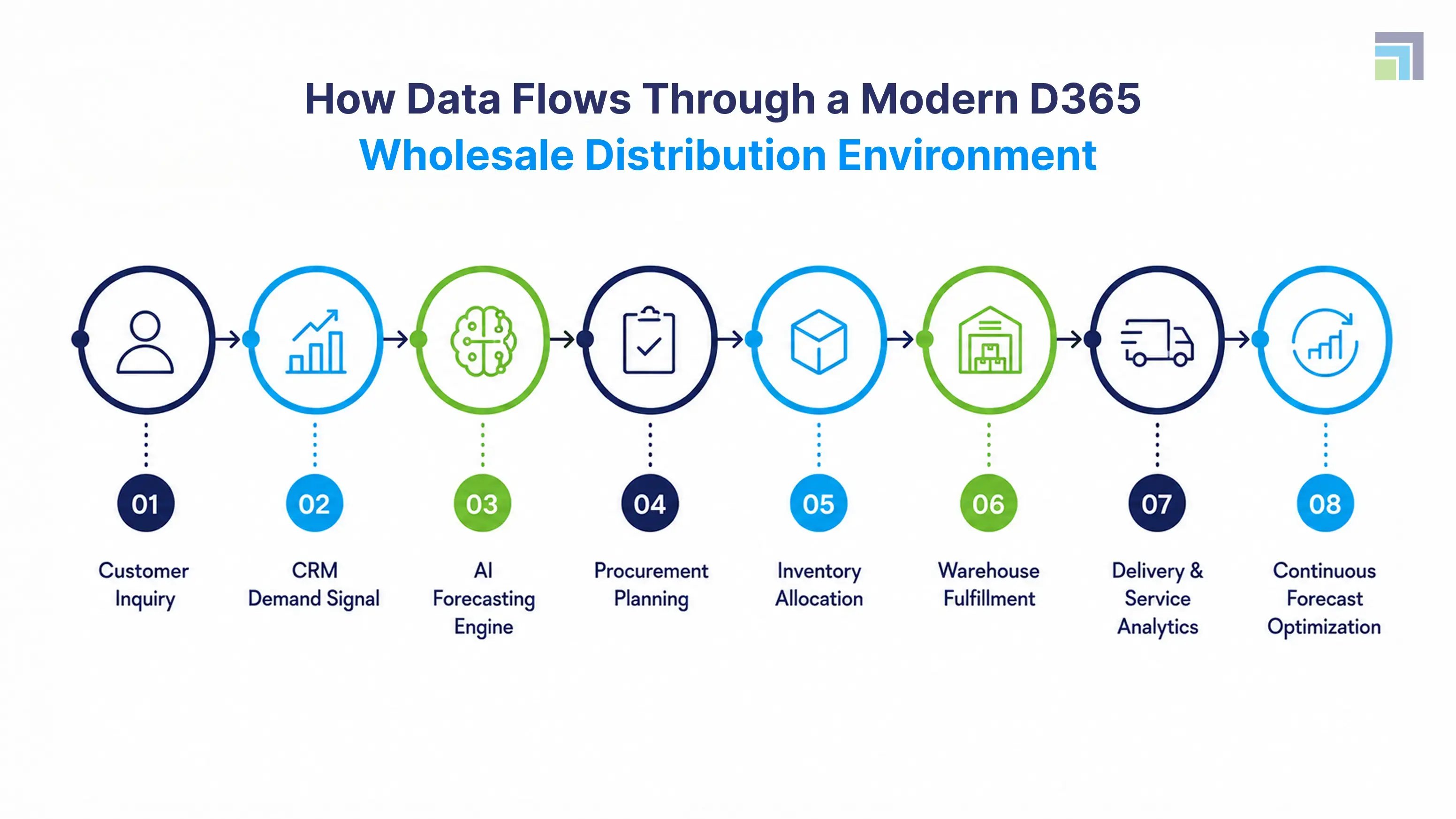
With connected CRM and ERP data, sales representatives can access inventory availability, expected replenishment timelines, and order fulfillment status directly during customer interactions, while also being able to ask shipment status questions in Teams. Procurement and warehouse teams gain visibility into upcoming demand shifts earlier, allowing them to prepare inventory and logistics resources proactively.
Dynamics 365 also supports intelligent order prioritization based on customer importance, inventory availability, shipping constraints, and delivery timelines.
This improves:
- Order accuracy
- Fulfillment speed
- Delivery reliability
- Warehouse coordination
- Customer communication
Wholesale distributors managing large dealer networks or multi-channel operations benefit significantly from this level of operational alignment. Instead of reacting to fulfillment issues after they escalate, businesses can identify risks earlier and adjust operational workflows in real time.
As fulfillment expectations continue rising across B2B and B2C distribution models, connected operations are becoming essential rather than optional.
Why Distribution Agility Now Depends on Connected Systems
Wholesale distribution is no longer driven by inventory volume alone. It is driven by how quickly businesses can interpret demand signals, align operations, and fulfill orders with precision.
Disconnected systems make that increasingly difficult. Unified platforms like Dynamics 365 help distributors connect CRM, Finance & Operations, inventory, fulfillment, and AI-driven forecasting into a single operational framework. The result is better visibility, faster decision-making, improved forecast accuracy, and more resilient fulfillment operations.
As a Dynamics 365 Partner, DynaTech helps wholesale distributors modernize demand forecasting wholesale distribution operations through Dynamics 365 implementation services, AI-driven planning, and intelligent supply chain solutions designed for long-term scalability and operational agility.
Looking to modernize your distribution operations with Dynamics 365? Connect with DynaTech to build a smarter, AI-powered forecasting and fulfillment ecosystem.