Choosing an MDM platform is becoming less about whether an organization needs master data management and more about where that MDM should sit within its data architecture.
For a Microsoft-centric enterprise, that question becomes more specific. If Microsoft Fabric is already becoming the foundation for data engineering, analytics, governance, and AI, should master data be built directly into that environment, or should an established multidomain MDM platform sit alongside it and integrate into the Fabric ecosystem?
That is where the comparison between DynaTech AI MDM and Semarchy becomes meaningful.
Both approaches address the problems that make enterprise data difficult to trust: fragmented records, inconsistent attributes, duplicate entities, disconnected data domains, governance gaps, and the growing need to provide reliable context to analytics and AI. But they approach the MDM architecture differently.
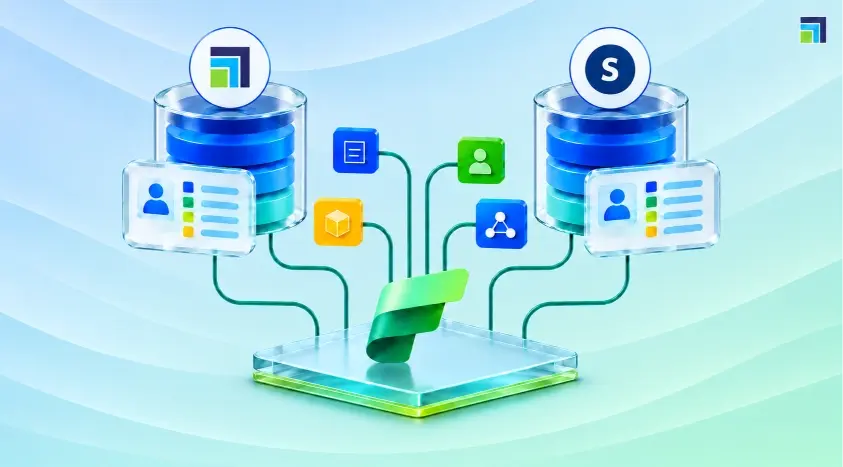
DynaTech AI MDM is designed around Microsoft Fabric, combining data quality, profiling, matching, governance, lineage, stewardship, and trusted master data distribution within a Fabric-based architecture. Semarchy takes a dedicated multidomain MDM approach, with capabilities spanning golden records, data quality, enrichment, stewardship, data products, and integration with Microsoft Fabric, Azure, and Purview.
So the decision is not simply DynaTech AI MDM vs Semarchy based on which platform has more MDM features. It is about architecture, Microsoft Fabric alignment, AI requirements, governance, integration, and the way an organization wants trusted master data to flow across its business.
For organizations evaluating master data management software or comparing MDM platforms for a Microsoft environment, understanding master data management on Microsoft Fabric helps clarify how MDM can fit into a broader data architecture.
Quick Answer
DynaTech AI MDM and Semarchy both provide capabilities for master data quality, governance, golden records, enrichment, and enterprise data management. DynaTech AI MDM is built natively on Microsoft Fabric, with Fabric and Purview forming part of its architecture. Semarchy provides a multidomain MDM platform that integrates with Microsoft Fabric, Azure, and Microsoft Purview.
DynaTech is particularly relevant for Microsoft-centric organizations wanting MDM designed directly into a Fabric-based data estate. Semarchy can suit organizations seeking flexible multidomain MDM with multiple MDM styles and Microsoft ecosystem integration.
What to Look for in Modern Master Data Management Software
Modern master data management software needs to solve more than duplicate records. A useful evaluation should examine how the solution creates, validates, governs, and distributes trusted master data.
Key considerations include architecture, data quality, golden records, entity resolution, governance, integration, AI readiness, and how trusted data is consumed by applications, analytics, and AI agents.
These criteria are more useful than comparing MDM platforms by feature count alone.
DynaTech AI MDM vs Semarchy: Comparing the Core Architecture
The core difference between DynaTech AI MDM and Semarchy is where master data management sits in the data architecture. The two approaches below show how each one fits into a Microsoft Fabric environment.
DynaTech AI MDM
DynaTech positions its MDM solution as AI-powered master data management built natively on Microsoft Fabric. Its architecture is designed around unified ingestion, governed processing, and delivery of trusted master data across the enterprise. The solution brings together ERP, CRM, and other enterprise sources, with Fabric Lakehouse Bronze, Silver, and Gold layers supporting governed master data.
Its service model also covers MDM strategy, design, implementation, Common Data Model design, enterprise data governance, metadata management, lineage, and stewardship enablement.
For a Microsoft-centric organization, this approach can reduce the architectural separation between MDM and the Fabric environment, making master data part of the governed foundation used for analytics and AI.
Semarchy MDM
Semarchy presents a multidomain MDM platform for operations, analytics, and AI. Its current positioning includes customer, product, supplier, and reference data, with capabilities such as certified golden records, multidomain 360 views, semantic modeling, data quality, enrichment, AI-assisted stewardship, and consumption interfaces.
Its platform supports multiple MDM styles, including Registry and hybrid approaches, which can help enterprises with different domain requirements or evolving MDM architectures.
Semarchy also positions its Microsoft collaboration around Azure, Fabric, and Purview integration. Its Microsoft partnership material describes deployment on Azure and integration with Microsoft Purview and Fabric, alongside DataOps tooling, catalog capabilities, and AI-enhanced stewardship.
DynaTech AI MDM vs Semarchy: Side-by-Side Comparison
|
Capability |
DynaTech AI MDM |
Semarchy MDM |
|
Architecture |
Built natively on Microsoft Fabric |
Multidomain MDM platform integrated with Microsoft ecosystems |
|
Fabric / OneLake |
Fabric-centered architecture |
Microsoft Fabric integration and data consumption |
|
Data quality |
AI-assisted profiling, matching, and 50+ AI-powered quality rules |
Data quality, enrichment, validation, and stewardship capabilities |
|
Golden records |
Consolidation of trusted master data |
Certified golden records |
|
Entity resolution |
AI-assisted profiling and matching |
Matching and multidomain consolidation |
|
AI |
AI-driven profiling, quality, matching, and AI-ready data |
AI-enhanced stewardship, enrichment, classification, and agentic data access |
|
Governance |
Fabric and Purview-based governance, metadata, lineage, stewardship |
Federated governance, workflows, lineage, catalog, and Purview integration |
|
Integration |
ERP, CRM, enterprise systems, analytics, AI, downstream systems |
Enterprise systems, Microsoft data estate, APIs and data products |
|
Analytics |
Trusted master data delivered to analytics and AI |
Master data and data products for analytics and AI |
|
Best fit |
Microsoft Fabric-centric organizations seeking a native MDM architecture |
Organizations seeking flexible multidomain MDM and Microsoft ecosystem integration |
The comparison shows why there is no universal winner. The decision depends on how the organization wants MDM to operate within its wider data estate.

Get More Control Over Your Enterprise Data
Bring data quality, governance, and master data management together with an approach designed for Microsoft Fabric.
Microsoft Fabric and OneLake: How the Two Approaches Fit the Data Estate
Microsoft Fabric changes the context in which organizations evaluate MDM. Instead of treating master data as a standalone repository, enterprises can connect governance, engineering, analytics, and AI around a unified data platform. This makes Master Data Management in Microsoft Fabric an important consideration when evaluating the two approaches.
DynaTech's approach is explicitly centered on Fabric. Its architecture uses Fabric Lakehouse layers for governed master data and delivers trusted data to analytics, AI, and downstream systems.
Semarchy, meanwhile, has developed its Microsoft integration around Fabric, Azure, Purview, Fabric data products, VS Code, and Copilot.
That distinction matters, but it should not be simplified into "native versus connected." The practical question is whether an enterprise wants MDM architected directly around Fabric or prefers a dedicated multidomain platform that integrates into that environment.
Data Quality, Golden Records, and Entity Resolution
Data quality is where MDM becomes operationally valuable. Customer names, supplier records, product identifiers, addresses, classifications, and reference values often differ between ERP, CRM, finance, ecommerce, and other systems.
DynaTech highlights AI-assisted profiling and matching alongside more than 50 AI-powered data quality rules. Its architecture also emphasizes data quality and consolidation before trusted master data is delivered to downstream consumers.
Semarchy similarly emphasizes data quality, enrichment, golden records, and multidomain 360 views. Its platform is designed to establish a trusted representation of entities across domains while supporting different MDM styles.
For buyers, the question is whether the solution can resolve entity variations, maintain a governed golden record, and make trusted information available where it is needed. See how AI MDM vs traditional MDM compares in terms of data quality and governance.
Master Data Governance and Stewardship
MDM and master data governance are closely connected, but they are not identical. MDM manages and distributes trusted master data, while governance establishes the policies, ownership, accountability, metadata, lineage, and controls around that data.
DynaTech's offering combines MDM with enterprise data governance, metadata management, lineage tracking, and stewardship enablement. It also positions Fabric and Purview as part of the governance architecture.
Semarchy approaches governance through federated workflows, auditable lineage, data stewardship, catalog capabilities, and Microsoft Purview integration. Its Microsoft materials also describe AI-enhanced stewardship for enrichment and classification.
Organizations should evaluate governance as an operating model, not simply another feature in a data governance tools comparison. Ownership, approvals, exceptions, lineage, and audit evidence determine whether MDM remains useful after implementation.
AI-Powered MDM: What AI Actually Does
AI-powered MDM should mean more than adding a chatbot to an MDM interface. The useful applications of AI are closer to the data management process itself.
|
AI capability |
DynaTech AI MDM |
Semarchy |
|
Profiling |
AI-assisted profiling |
AI-enhanced data capabilities |
|
Validation |
AI-powered data quality rules |
Data quality and workflow support |
|
Matching |
AI-assisted matching |
Matching and entity resolution |
|
Duplicate detection |
Supported through profiling and matching |
Supported through MDM matching capabilities |
|
Enrichment |
Part of the broader MDM process |
AI-assisted enrichment |
|
Stewardship assistance |
Stewardship enablement within governed MDM |
AI-powered stewardship |
|
Classification |
Governance and quality architecture |
AI-assisted classification |
|
AI-ready data |
Trusted master data delivered to AI systems |
Trusted contextual master data for AI and agents |
DynaTech explicitly identifies AI-assisted profiling and matching and 50+ AI-powered data quality rules as key capabilities. Semarchy emphasizes AI-powered stewardship, enrichment, classification, and access to contextual master data for AI agents.
The stronger approach depends on what the enterprise expects AI to do. If the priority is improving the MDM pipeline itself within a Fabric architecture, DynaTech's Fabric-centered model may be attractive. If the priority includes AI-enhanced stewardship and delivering contextual master data to agentic applications through a multidomain platform, Semarchy may warrant closer evaluation.
Integrating MDM With ERP, CRM, Analytics, and AI
An MDM platform creates value only when trusted data reaches the systems that depend on it.
DynaTech's architecture explicitly includes unified ingestion from ERP, CRM, and enterprise systems, followed by governed processing and distribution to analytics, AI, and downstream systems. This is particularly relevant for organizations with Microsoft Dynamics 365, other enterprise applications, and Fabric-based analytics.
Semarchy also focuses on multidomain data products and consumption interfaces, with its Microsoft materials highlighting integration into Fabric and data product development workflows.
Map the complete data flow from source systems through matching, governance, golden records, publication, analytics, and operational consumption. Integration complexity can matter as much as product capability. Organizations planning this integration can also explore DynaTech's data and AI modernization services to align MDM with their wider data architecture.
When DynaTech AI MDM May Be the Better Fit
DynaTech AI MDM may be particularly suitable when:
- Microsoft Fabric is already a strategic data platform.
- The organization wants MDM built natively within its Fabric architecture.
- ERP, CRM, analytics, and AI workloads need a common governed data foundation.
- AI-assisted profiling, matching, and data quality are important.
- Governance, metadata, lineage, and stewardship need to be designed alongside MDM.
- The organization wants trusted master data distributed directly to analytics and AI systems.
DynaTech describes its MDM approach as a unified Fabric-based architecture designed to transform fragmented enterprise data into governed and AI-ready master data.
Make Your Microsoft Fabric Data AI-Ready
Bring data quality, governance, and trusted master data together with DynaTech AI MDM. Build a stronger foundation for enterprise analytics and AI.
When Semarchy May Be the Better Fit
Semarchy may be a strong fit for organizations that want:
- A dedicated multidomain MDM platform.
- Flexibility across different MDM styles.
- Certified golden records and multidomain 360 capabilities.
- AI-assisted stewardship, enrichment, and classification.
- Data products and consumption interfaces.
- Deep integration with Microsoft Fabric, Azure, and Purview without requiring MDM itself to be the core Fabric-native architecture.
The choice should reflect the organization's operating model, investments, integration landscape, governance maturity, and long-term data strategy.
DynaTech AI MDM as a Semarchy MDM Alternative
For organizations searching for a Semarchy MDM alternative, the most relevant question is not whether one product has more features. It is whether the architecture aligns with the enterprise's technology direction.
DynaTech can be compelling for Microsoft-centric organizations that want MDM, governance, analytics, and AI closer together within Microsoft Fabric. Its offering spans strategy, implementation, Common Data Model design, governance, metadata, lineage, stewardship, data quality, and trusted master data delivery.
That makes the decision less about replacing one MDM product with another and more about choosing the operating model that best supports the organization's next phase of data modernization.
How to Choose the Right MDM Platform
Before selecting among master data management tools, decision makers should answer five questions:
- Where should master data live within the enterprise architecture?
- How will the platform integrate with ERP, CRM, analytics, and AI systems?
- What level of automation is required for profiling, matching, validation, enrichment, and stewardship?
- How will governance, lineage, ownership, and auditability be maintained?
- Does the MDM strategy support the organization's future Fabric and AI roadmap?
These answers provide a better basis for evaluating MDM platforms than a feature-count comparison.
Build a Fabric-Ready Master Data Strategy with DynaTech
The right MDM strategy should create more than clean records. It should establish a trusted data foundation that business applications, analytics teams, and AI systems can rely on.
As a Microsoft Solutions Partner, DynaTech combines MDM strategy and implementation with Microsoft Fabric, governance, metadata, lineage, stewardship, data quality, and AI readiness. Its stated objective is to deliver clean, governed, continuously synchronized master data across operational and analytical processes.
For organizations already investing in Microsoft Fabric, this approach provides a practical path to make master data part of the wider data platform rather than another disconnected data initiative. Learn how trusted AI and analytics with MDM in Fabric can support your enterprise data estate.