 04 Aug 2026
Organizations spend millions on ERP implementations, customizations, and training. Yet a surprisingly large number of them still run on data that is incomplete, duplicated, or inconsistently formatted across departments. The root cause, in most cases, isn't the ERP platform. It's the absence of a disciplined ERP Master Data Management strategy.
Master data like your customers, vendors, products, financial entities, etc., is the connective tissue of your entire enterprise. When that data is unreliable, every downstream process suffers: procurement decisions are based on guesswork, financial reporting takes longer to reconcile, and ERP business intelligence dashboards become largely decorative. This blog breaks down the most common mistakes organizations make with ERP data management, why ERP data governance matters, and what a modern governance approach actually looks like.
- 67%of organizations say they don't completely trust their data for decision-making
- 70% of manufacturers cite data quality as the most significant obstacle to AI implementation.
Numbers like these don't lie. And yet, despite widespread awareness of the problem, organizations keep making the same avoidable mistakes. Let’s have a look at some of the common ERP data migration challenges that transform the entire business landscape.
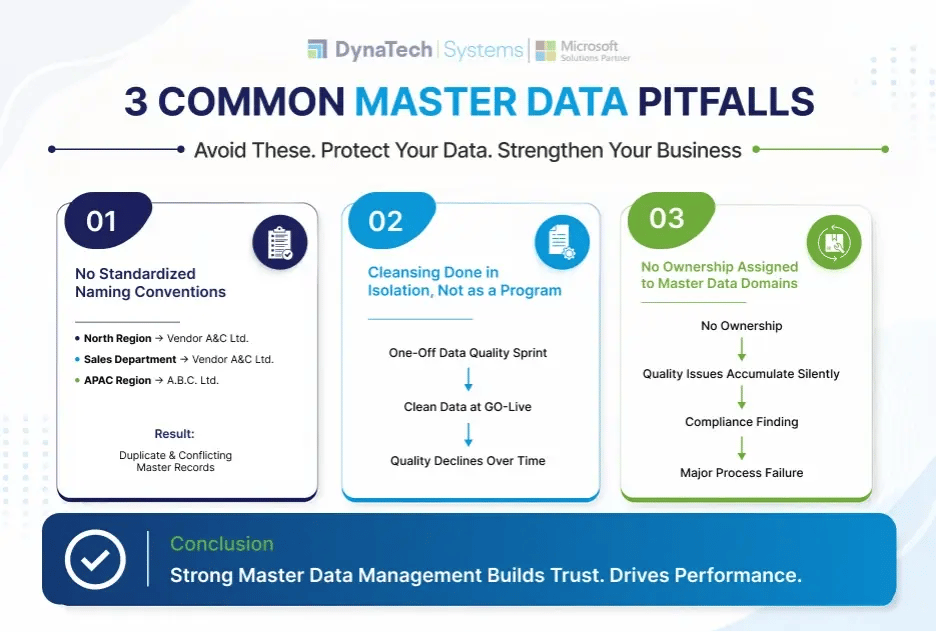
Mistake #1: Treating ERP Data Management as a One-Time Migration Task
The most pervasive misconception in enterprise data programs is that ERP data management ends at go-live. Teams spend months cleansing legacy records, mapping fields, and running scripts and then consider the job done. What happens next is predictable: without ongoing compliance, quality of the data degrades within weeks.
ERP data migration issues don't resolve themselves post-implementation. New vendors get added without any kind of standard naming convention. Product records get duplicated across business units. Customer accounts gather errors over time. A new ERP doesn't fix unmanaged data; it inherits it and then magnifies it across every integrated system.
Sustainable enterprise master data management requires a lifecycle approach. Effective master data governance for ERP environments brings together governance policies, stewardship roles, and automated monitoring that run continuously, not just at migration time. For organizations that need ongoing support to maintain and optimize their ERP environment, Dynamics 365 Managed Services can help sustain these governance practices beyond the initial implementation.
Mistake #2: Skipping ERP Data Cleansing Before Governance
Enterprises that rush ERP integration without a clean data foundation are essentially building on sand. ERP data cleansing isn't just deduplication; it is a critical part of ERP data quality management that also involves standardizing formats, resolving conflicting records, and developing trusted reference data before new workflows depend on it. This step becomes even more critical during Dynamics 365 migration services, where poor-quality legacy data can quickly undermine the value of the new ERP environment.
Consider a global distributor running three regional ERP instances. The same vendor might be listed as "Acme Corp," "ACME Corporation," and "Acme Corp. Ltd." across those systems. Without centralized governance, procurement teams are operating with a fractured supplier picture. This simply impacts negotiated terms, spend analytics, and audit.
Mistake #3: Neglecting the Impact on ERP Business Intelligence
Poor ERP Master Data Management doesn't just create operational friction. It actively undermines your capability to trust the numbers your reporting layer produces. When the same customer appears under multiple records, your revenue figures are overstated. When product codes are inconsistent, inventory valuations become non-trustable. When vendor hierarchies are incomplete, spend analysis misses consolidation opportunities worth millions.
This is why ERP business intelligence initiatives so frequently stall. The analytics infrastructure may be sound; Power BI for Dynamics 365 reports built, dashboards configured, but if the master data feeding them is inconsistent, every downstream insight is compromised. Finance teams know this intuitively: they spend hours reconciling data before a board presentation, not because the ERP is broken, but because the master data inside it was never properly governed.
For organizations using Microsoft Dynamics 365, Dynamics 365 MDM provides a structured way to govern the customer, vendor, product, and financial data that powers operational processes and reporting.
|
Area |
Without MDM Governance |
With Proper ERP MDM |
|
Vendor Records |
Duplicates across regions, mismatched spend data |
Unified golden record, clean procurement analytics |
|
Product Data |
Inconsistent codes, BOM errors, inventory discrepancies |
Standardized hierarchy, reliable inventory valuation |
|
Financial Entities |
Misaligned legal entities, reconciliation delays |
Audit-ready structure, faster close cycles |
|
ERP Reporting |
Low-trust dashboards, manual data prep before every report |
Real-time BI with reliable master data as the foundation |
|
ERP Migrations |
High-risk, data-heavy cutover with costly last-minute cleansing |
Governed migration with clear data lineage and reduced risk |
Mistake #4: Treating ERP Integration Solutions as a Data Governance Substitute
Many organizations invest in ERP integration solutions; connecting D365 to their CRM, e-commerce platform, or third-party logistics, etc. under the assumption that clean integrations will resolve data quality issues. They won't. Integration moves data between systems. It doesn't clean it, validate it, or enforce consistency in how it's created in the first place.
If a customer record in your CRM is missing a tax ID and that record syncs to your ERP, you now have the problem in two systems instead of one. ERP data integration must be preceded by governance policies that define what "complete" and "valid" look like at the point of record creation and not after the fact.

Is Your ERP Running on Trusted Master Data?
DynaTech's D365 MDM Accelerator brings structured governance, audit workflows, and compliance-ready data management natively inside Dynamics 365 F&SCM without requiring a separate MDM platform.
What ERP Master Data Management Actually Requires
Getting ERP Master Data Management right is less about buying a platform and more about building a program. A practical ERP governance framework brings together governance policies, defined ownership, change-controlled workflows, and continuous monitoring across the master data domains your business runs on.
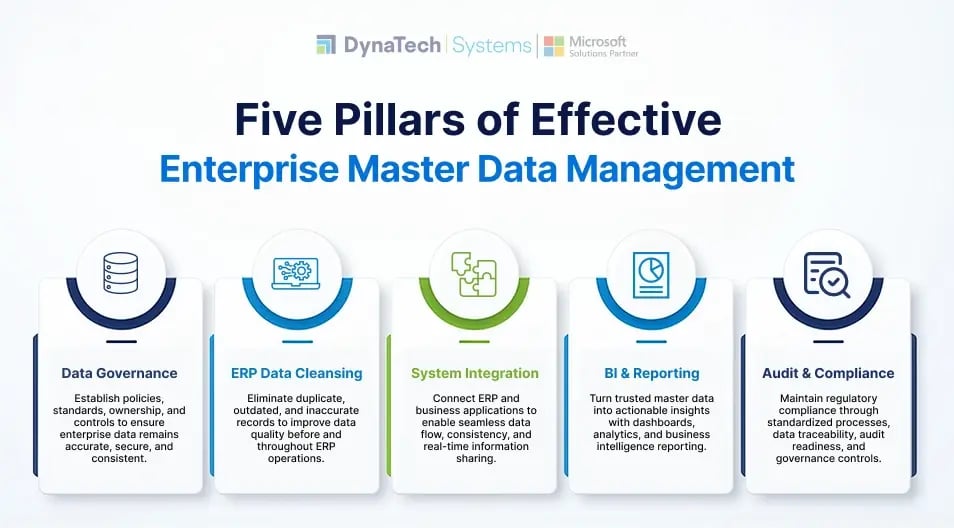
For organizations running Microsoft Dynamics 365 Finance & Supply Chain Management, this is exactly what purpose-built MDM for Dynamics 365 solutions are designed to solve. Rather than building governance from scratch or bolting on a standalone platform, they embed structured workflows; stewardship, approvals, and audit logging directly inside the ERP your teams already use every day.
Introducing DynaTech's D365 MDM Accelerator for Dynamics 365 F&SCM
DynaTech's D365 MDM Accelerator is a no-code/low-code master data governance in Microsoft Dynamics 365 solution built natively inside Microsoft Dynamics 365 Finance & Supply Chain Management. It's designed for organizations that need enterprise-grade ERP Master Data Management without the cost, complexity, or disruption of deploying a separate MDM platform alongside their ERP.
Available on Microsoft AppSource, the DynaTech’s D365 MDM accelerator covers the four master data domains that drive the most operational risk when left ungoverned: customers, vendors, products, and financial entities. Each domain gets controlled creation and change workflows, field-level validation rules, duplicate detection, and a complete audit log; all managed within D365.
- Change Request Workflows
Every master data update; whether a new vendor onboarding or a product reclassification, goes through a configurable approval chain before it's published to legal entities. No more uncontrolled edits by individual users. - Data Quality Rules Engine
Set up intelligent data validation with field-level validation rules, mandatory field checks, and duplicate detection logic that run at the point of entry, so errors are caught before they enter the system, not discovered weeks later in a report. - Role-Based Data Access
Control who can create, edit, validate, or approve each master data domain. Assign field ownership to the right team member, with time-bound tasks and parallel entry support for complex records. - Audit-Ready Compliance Logs
Every change to master data; who requested it, who approved it, what changed, and when is automatically logged. Audit prep that used to take days is reduced to a filtered query. - ERP Data Migration Templates
Pre-built import templates accelerate the migration of accurate, validated data from any legacy ERP or file into D365 F&SCM, with staging table validation before any record goes live. - ERP Integration Ready
Configure and monitor complex ERP data integration with any application within or outside D365 F&SCM without writing code. Validated data flows out as cleanly as it flows in.
What Organizations Achieve with the D365 MDM Accelerator
- Single golden record per entity like customer, vendor, product, and financial across all legal entities
- Audit-ready change history with role-based approval workflows embedded natively in D365
- Faster, lower-risk ERP data migration using pre-validated staging templates
- Reliable foundation for ERP business intelligence reports your finance team can stand behind
- Reduced ERP data integration errors through point-of-entry validation, not post-migration cleanup
- Compliance readiness without the overhead of maintaining a separate MDM platform
The Bottom Line
Every organization running on Dynamics 365 has made a significant investment in its licensing and optimization. But that investment only delivers its full return when the master data underneath it is correct and governed. Without that foundation, the ERP becomes an expensive system of record information that cannot be trusted.
The mistakes covered in this blog aren't edge cases. They're the norm. And the cost shows almost everywhere. Fixing this doesn't require starting over. It requires putting governance in place; at the point of entry, across every master data domain, with the right approvals, validations, and audit trails built into the workflows people already use. That's precisely what a purpose-built accelerator for ERP Master Data Management is designed to do.
If your organization is ready to move from reactive data cleanup to proactive governance, the right next step is a conversation with a reliable Dynamics Implementation Partner like DynaTech Systems.
Ready to Fix Your ERP Master Data for Good?
See how DynaTech's D365 MDM Accelerator can bring governed, audit-ready master data management inside your existing Dynamics 365 environment.