%20in%20Dynamics%20365.webp)
 07 Jul 2026
For years, Dynamics 365 Finance and Operations development was built around cloud-hosted environments. Developers logged into dedicated VMs, deployments were coordinated through Lifecycle Services, and most operational control stayed within isolated Finance and Operations workflows.
That approach is now gradually being replaced by a more connected development model.
Microsoft’s Dynamics 365 Finance and Operations Unified Developer Experience brings development, deployment, administration, and environment management closer to the broader Power Platform ecosystem. Instead of relying heavily on VM-centric workflows and LCS-driven operations, the newer model introduces PPAC-managed environments, local development workflows, CI/CD-oriented deployments, and native Dataverse alignment.
This changes more than where environments are managed. It changes how development itself operates across Dynamics 365 Finance and Operations workloads.
Under the newer Unified Developer Experience, developers work through locally installed Visual Studio environments connected to cloud-managed workloads, deployments move through more structured pipeline-driven processes, and DEV, USE, and UPE environments function within a unified operational framework managed through the Power Platform Admin Center Dynamics 365 experience.
For developers and solution architects, understanding the UDE Dynamics 365 model is becoming increasingly important as Microsoft continues moving Finance and Operations environments toward standardized SaaS operations and more centralized platform governance.
What Is Unified Developer Experience?
The Unified Developer Experience is Microsoft’s modern development and environment model for Dynamics 365 Finance and Operations applications. It combines development, deployment, administration, and environment management into a more connected operational framework managed through PPAC.
In the traditional model, development environments were typically provisioned as cloud-hosted virtual machines through Lifecycle Services. Developers connected directly to VM-based environments, and deployments could be coordinated manually, and administration workflows remained largely separated from Power Platform governance.
Under the newer D365 unified developer experience model, development becomes more cloud-connected and operationally aligned with the broader Microsoft business application ecosystem.
The newer framework introduces several foundational changes:
- Local Visual Studio development connected to cloud-hosted environments
- PPAC-managed environments replacing traditional LCS-centric operations
- CI/CD-oriented deployment workflows
- Native Dataverse integration
- Standardized administration across Dynamics 365 and Power Platform services
This is also where the unified development experience concept becomes important. Microsoft is no longer treating Finance and Operations environments as isolated ERP workloads.
Instead, development and administration are gradually being aligned with the same operational structure used across Power Platform integration with Dynamics 365 F&O services.
For organizations already working across automation, analytics, AI, and Dataverse workloads, this creates a more connected environment model where development and governance operate within a shared platform architecture.
Understanding DEV, USE, and UPE Environments
At the center of the Unified Developer Experience model is a new environment structure that replaces many of the traditional LCS-based environment concepts.
Instead of relying on cloud-hosted development VMs, sandbox environments, and isolated deployment coordination, Microsoft now organizes Finance and Operations workloads into three primary environment types:
- DEV (Unified Developer Environment)
- USE (Unified Sandbox Environment)
- UPE (Unified Production Environment)
Organizations adopting this newer environment model often begin by planning their LCS to PPAC migration to ensure existing development, testing, and production processes transition smoothly.
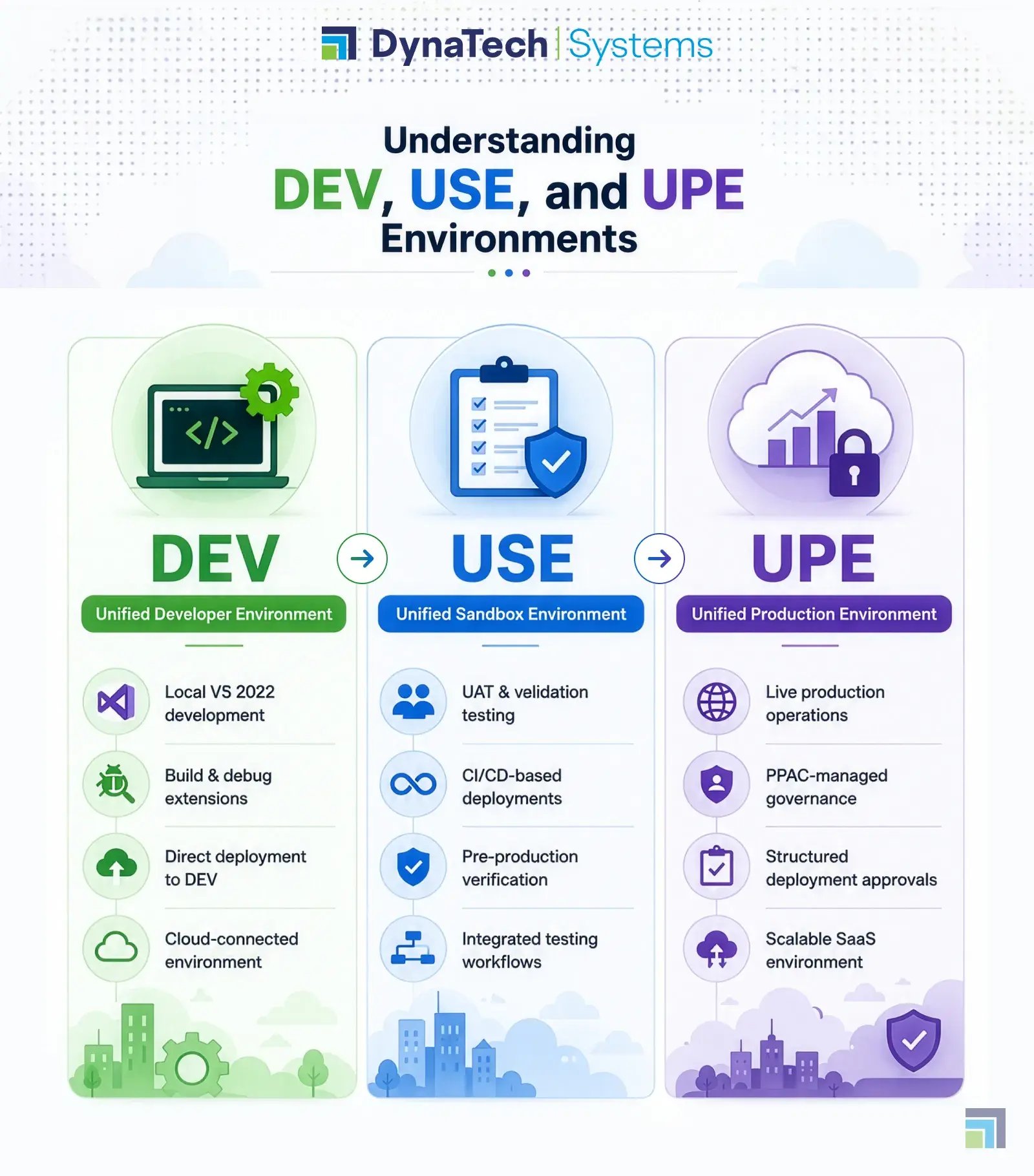
DEV: Unified Developer Environment
The DEV environment is designed specifically for development activities.
Under the unified developer experience for finance and operations, developers typically work through locally installed Visual Studio environments connected directly to cloud-hosted development environments managed through PPAC.
This represents a major change from the older VM-based development model commonly associated with Lifecycle Services.
Within the DEV environment, developers can:
- Build and extend Finance and Operations applications
- Deploy models directly to cloud-hosted development environments
- Perform debugging and validation activities
- Connect development workflows to Azure DevOps pipelines
- Work with Dataverse-connected workloads more naturally
This transition also reduces dependency on traditional cloud-hosted development VMs and VHD-based setups.
For organizations still operating under the older D365 finance and Operation OneBox unified developer experience mindset, this becomes one of the most significant operational changes introduced by UDE.
USE: Unified Sandbox Environment
The USE environment functions as the centralized sandbox and validation layer within the newer architecture model.
Unlike DEV environments, USE environments are not intended for direct development activities. Instead, they support:
- User acceptance testing
- Validation workflows
- Pre-production verification
- Integrated testing activities
- Deployment validation through CI/CD pipelines and structured RSAT adoption in Dynamics 365 Finance and Operations workflows.
One of the biggest changes under the newer D365FO unified developer experience model is that deployments into USE environments are expected to move through structured deployment pipelines rather than manual deployment approaches.
This aligns closely with Microsoft’s broader SaaS direction, where deployment orchestration becomes more controlled, standardized, and governance-driven across environments.
USE environments also play an important role in reducing inconsistencies between development and production operations by enforcing more structured deployment practices before workloads reach production.
UPE: Unified Production Environment
The UPE environment represents the production layer within the newer architecture structure.
Under the newer Dynamics 365 Unified Developer Experience model, production environments are managed through PPAC rather than traditional LCS-centric operational workflows.
UPE environments introduce several operational differences compared to older production models:
- Centralized administration through PPAC
- Automated scaling behavior
- Standardized governance controls
- Unified operational visibility
- Structured deployment approvals
This also changes how production governance is handled. Instead of relying heavily on isolated ERP administration models, production operations become more closely aligned with broader Power Platform governance and operational controls.
For organizations managing multiple Finance and Operations environments across regions or business units, this creates more consistent administration and monitoring practices across workloads.
How UDE Changes Development and Deployment
One of the biggest differences introduced by the Unified Developer Experience involves how development and deployment workflows operate across environments.
Under the traditional LCS model, development environments were heavily dependent on cloud-hosted virtual machines. Developers often worked directly inside those environments, and deployment flexibility allowed both manual and automated approaches across sandbox and production environments.
The newer UDE Dynamics 365 model changes that operational structure significantly.
Development workflows now move closer toward modern CI/CD-oriented practices where local development environments connect directly to cloud-hosted workloads managed through PPAC.
This introduces several operational changes:
- Developers work through local Visual Studio 2022 environments to speed up D365 plugin coding with AI.
- Environment provisioning happens through PPAC
- Metadata synchronization becomes cloud-connected
- Azure DevOps pipelines play a larger role in deployment orchestration
- Unified deployment packages become part of the deployment lifecycle
The deployment process itself also becomes more structured.
Within the newer architecture model:
- Development deployments can occur directly into DEV environments
- Sandbox and production deployments are expected to move through Azure DevOps pipelines
- Release governance becomes more centralized
- Deployment sequencing becomes more standardized across environments
This is one of the reasons Microsoft positions the Unified Developer Experience as more than a tooling update. It changes how development operations, deployment governance, and environment management work together across Finance and Operations workloads.
Benefits of the UDE Architecture
The newer UDE architecture introduces several operational and development advantages compared to older LCS-centric models.
One of the biggest improvements involves environment standardization. By aligning development, administration, and deployment workflows within PPAC-managed environments, organizations gain a more connected operational model across Dynamics 365 and Power Platform workloads.
Other key advantages include:
Faster Environment Provisioning
Traditional cloud-hosted environments often required lengthy provisioning and setup activities. Under the newer model, environment provisioning becomes more streamlined through PPAC-managed operations.
Reduced Infrastructure Dependency
The Unified Developer Experience reduces dependency on dedicated cloud-hosted development VMs and customer-managed Azure infrastructure for development activities.
Improved CI/CD Alignment
Deployment orchestration becomes more consistent through Azure DevOps pipeline integration and structured release management practices.
Native Dataverse Integration
The newer environment model supports stronger integration with Dataverse and broader Power Platform services, reducing operational fragmentation between Finance and Operations workloads and the wider Microsoft ecosystem.
Centralized Governance
By operating through Power Platform Admin Center Dynamics 365, organizations gain more centralized administration, monitoring, and governance visibility across environments supported through structured Dynamics 365 managed services.
For development teams already modernizing deployment pipelines and operational governance models, these improvements create a more scalable long-term environment structure.
Understanding the UDE Architecture and PPAC Environment Model
The UDE architecture is designed around a more centralized operational model where development, sandbox, and production environments are managed within the broader PPAC ecosystem.
Under this structure, PPAC acts as the primary management layer across DEV, USE, and UPE environments.
This changes several operational behaviors compared to traditional LCS-centric environments:
- Environmental administration becomes centralized
- Governance policies and Dynamics 365 F&SCM licensing and security enforcement practices operate more consistently across environments.
- Deployment orchestration aligns across environments
- Monitoring visibility becomes more unified
- Dataverse integration becomes native to the architecture model
The environmental flow itself also becomes more structured:
DEV → USE → UPE
This progression reinforces Microsoft’s broader SaaS operational direction, where development and deployment activities move through governed operational stages rather than isolated ERP administration workflows.
The transition becomes easier to understand when comparing the older LCS environment structure with the newer Unified Developer Experience model.
LCS Environment Model vs UDE Environment Model
| Traditional LCS Model | Unified Developer Experience Model |
| Cloud Hosted Environment (CHE) | DEV |
| Sandbox Environment | USE |
| Production Environment | UPE |
| VM-based development | Local VS + cloud-connected environments |
| Manual and automated deployments | CI/CD-oriented deployments |
| LCS-centric administration | PPAC-managed administration |
| Separate governance models | Unified governance structure |
This comparison highlights why Microsoft positions the newer Unified Developer Experience model as part of a broader modernization effort rather than a simple environment redesign.
How DynaTech Supports UDE Adoption
Adopting the Dynamics 365 Unified Developer Experience often requires more than environment migration alone. Organizations also need to modernize development workflows, deployment orchestration, governance structures, and operational practices built around traditional LCS environments. As a Microsoft Solutions Partner, DynaTech helps organizations navigate this transition with proven expertise across the Dynamics 365 ecosystem.
DynaTech works with organizations to support this transition through:
- UDE environment planning and architecture alignment
- PPAC readiness assessments
- DevOps and CI/CD modernization initiatives
- Deployment workflow restructuring
- Governance and operational alignment across environments
- Validation of customizations, ISVs, and deployment dependencies
For organizations moving toward PPAC-managed environments, the focus is not simply on replacing older development models. It is about building development and deployment processes that align with Microsoft’s broader platform direction going forward.

Conclusion: Development in Dynamics 365 Is No Longer VM-Centric
For a long time, Dynamics 365 Finance and Operations development was closely tied to cloud-hosted VMs, LCS-managed environments, and isolated deployment workflows. The Unified Developer Experience changes that foundation completely.
With DEV, USE, and UPE environments managed through PPAC, Microsoft is moving toward a model where development, deployment, governance, and platform operations work as part of the same ecosystem rather than separate operational layers.
For developers and architects, this is not just a new environment structure. It changes how code moves across environments, how deployments are governed, and how Finance and Operations workloads integrate with the broader Power Platform ecosystem.
As the Dynamics 365 Unified Developer Experience continues expanding, understanding the underlying architecture and operational model will become increasingly important for teams building modern Finance and Operations environments.